
In September, Milton police said their camera cases “remain under investigation.” One officer had resigned in July.
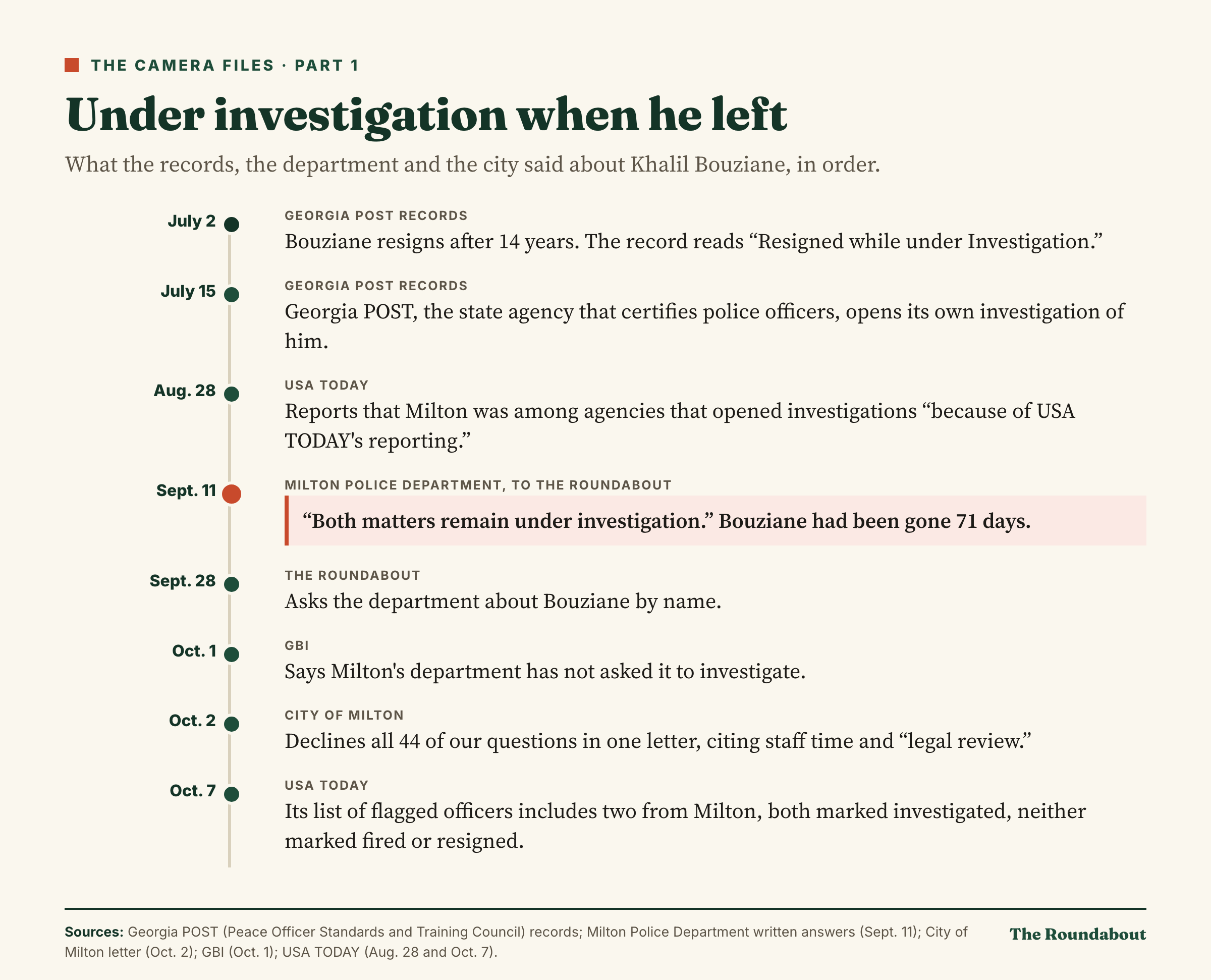
State records show Khalil Bouziane, one of two Milton officers on USA TODAY’s list, resigned “while under Investigation” on July 2. Seventy-one days later, the department told us its two camera cases “remain under investigation.” It hasn’t named him publicly.

On Friday, Sept. 11, Milton’s Police Department answered our questions about its license plate cameras in writing. One answer was about misuse. The department said it had “reviewed search activity and identified two matters that warranted further investigation as potential misuse. Both matters remain under investigation.”
By then, one of the two Milton officers on USA TODAY’s list had been gone for 71 days.
Khalil Bouziane joined the Milton Police Department on Jan. 3, 2012. He resigned on July 2. The state agency that certifies police officers, the Georgia Peace Officer Standards and Training Council, or Georgia POST, records his separation as “Resigned while under Investigation.”

POST opened its own case on him on July 15, and as of Sept. 28 that case was still open. “Bouziane is currently under investigation,” a POST records officer wrote to us that day. POST said it couldn’t discuss an active case. He is one of the two Milton officers on USA TODAY’s list of officers flagged for unusual camera searches. POST’s record doesn’t say what the investigation concerned, and nothing we hold says whether it is one of the department’s camera cases. A record of an investigation is not a finding of wrongdoing.
In police terms, “remain under investigation” means a case is still open. It doesn’t say where the officer is. The department’s Sept. 11 answer didn’t mention that he was gone.
An investigation can continue after an officer leaves, and POST’s has. But neither the city’s news releases nor the department’s answers to us have named Bouziane or said he left. We asked about him by name on Sept. 28. Four days later, City Manager Steven Krokoff declined that question and 43 others in a single letter, citing the staff time and “legal review” that answering would take. The city hasn’t answered a question about Bouziane since.
This is Part 1 of two. USA TODAY’s list of officers flagged by its reporting includes a second Milton officer. He has until Wednesday to answer our questions, and we’ll report on him Thursday.
What the cameras see
If you’ve driven past one of Milton’s 36 license plate cameras in the past year, the Police Department can pull up a photo of your car and its plate. That goes for your teenager’s car, too. The cameras are made and run by a company called Flock Safety. The city used to keep those records 30 days; since October 2025, it keeps them searchable for a year.
Plate readers also ride on 39 marked police cars, and officers can search all of it, along with cameras run by other police agencies and 15 private feeds from neighborhoods and businesses. Our map shows every camera we have found.
The department says the system has guardrails. Each officer has a personal account. Every search, it told us, must serve “a legitimate law-enforcement purpose and include the required case, CAD or purpose information,” meaning a case number, a 911 dispatch call number or a stated reason.
Software flags some searches for “a three-member Department audit team” to review. Not every search gets a supervisor’s look in advance. Georgia law makes obtaining or using the data for anything but law enforcement “a misdemeanor of a high and aggravated nature.”

What the searches show
In the search logs we could get, most Milton searches from January 2023 through May 2026 showed no case number. The department’s 2018 order on plate readers says “a corresponding case number must be entered per GCIC rules.” (GCIC is the state office that runs Georgia’s criminal records systems.)
Flock keeps a running record of searches, called an audit log, and when another police agency’s cameras are searched, that agency’s log shows the search. Twenty-seven agencies have released their logs to the public under records laws. In those logs, we counted 18,341 searches by Milton users from January 2023 through May 2026. About nine in ten, 16,640, showed no case number, and the share with one fell every year, from 12.9 percent in 2023 to 6.1 percent in the first five months of 2026. That may have changed this summer: copies of July 2026 logs posted online by a third party, which we have not checked against the agency’s original files, show case numbers on 143 of 181 Milton searches.
The logs show only searches that reached other agencies’ cameras, and only what was typed into Flock, not what’s in the department’s own files. We sent the department these findings on Oct. 5 and offered the date, time and search ID of every search we counted. It hadn’t responded by our deadline, 5 p.m. Monday.

How it came out
USA TODAY keeps a list of the people its Flock reporting has flagged. As of Oct. 9, it counted 30 nationwide, 12 at Georgia agencies and two at the Milton Police Department. The paper says the agencies on its list launched investigations, suspended or fired officers, or filed charges after it asked about their employees’ “unusual Flock search patterns.” It marks Bouziane as investigated, not as resigned. State records show he had already resigned in July.
Being on that list isn’t a finding that anyone broke a rule or the law, and the list doesn’t say what anyone searched, or why. The department says its own review of search activity turned up the two matters. USA TODAY reported on Aug. 28 that Milton was among the agencies that “launched criminal or administrative investigations into officers because of USA TODAY’s reporting.”
How the program grew
Council approved nine cameras in February 2022, under a contract that said footage would be deleted after 30 days, at $22,500 a year. Today the city runs 36 cameras, keeps what they record for a year, and placed $106,200 in Flock purchase orders in the budget year that ended Sept. 30. In Council’s agendas and posted minutes since 2021, we found no vote on the added cameras or on keeping the data longer.
From the 2022 vote through June 25, 2026, the last date in the city’s posted checkbook, Milton paid Flock $339,235.62. Of that, $51,250 matches, line for line, what Council approved in 2022. The rest, $287,985.62, went to added cameras, longer storage and renewals at higher prices, and no Council agenda item or posted minutes names those purchases. The first nine added cameras came in February 2023, under Chief Rich Austin, who stepped down that December; Jason Griffin has been chief since. The department told us the Chief and the City Manager authorized the move to a year. It chose a year, it said, because “relevant vehicle information may not emerge within seven or 30 days,” and it says the change “appears in our published budget book.” The fiscal 2026 budget book has one line on it: “Expansion of stationary LPR program to enhance city wide coverage to include upgraded software to extend retention of data.” It gives no number of cameras or days, and the copy on the city’s website is dated December 2025, after Council’s Sept. 15, 2025 budget vote.
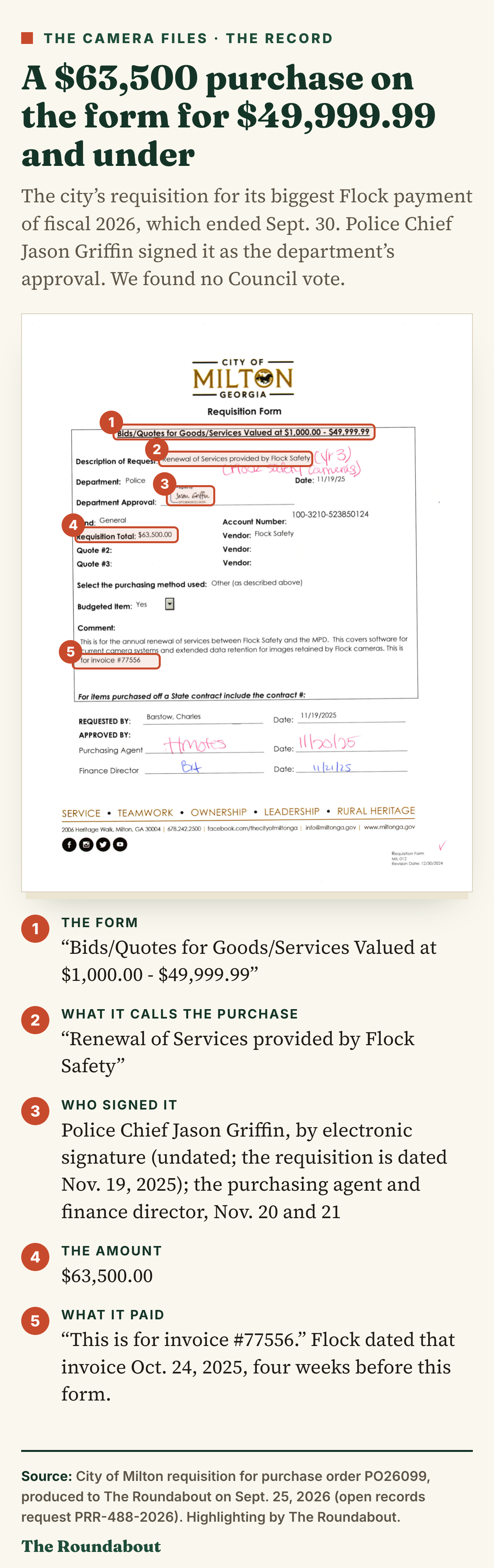
In the city’s paperwork, Flock’s bills came before the city’s sign-offs. For the $16,200 order, the year-long retention and two more cameras, the city’s written request to buy, called a requisition, is dated Sept. 29, 2025, and a purchase order Oct. 1. Flock billed on Oct. 23, and the city’s purchasing agent and finance director signed off on Oct. 29 and 30. Another Flock bill, for $26,500 and six more cameras, was dated Oct. 14 and due Nov. 13. The requisition asking to pay it is dated Nov. 19, six days after the due date. Flock’s $63,500 bill came Oct. 24; its requisition is dated Nov. 19, too.
All three requisitions were filed on the city’s form for purchases of $1,000 to $49,999.99, including the one for $63,500. That one was charged to the same account Council approved in 2022 for nine cameras at $22,500 a year. Each calls the purchase a “Renewal of Services,” and all three carry the same comment, word for word, about “extended data retention,” though two of the bills they paid charge for no retention. Flock’s invoices call two of them “Year 1” of a new 24-month term. Police Chief Jason Griffin signed all three as the department’s approval. None went to Council.
Three of the cameras came out of a parks project. In the 2024 and 2025 budgets, Council approved $75,000 a year for “a cloud based access control and video surveillance system at all City facilities and parks.” The first money spent from that parks project, $10,950 in February 2025, went to Flock for three plate readers. The budget pages Council saw don’t mention Flock or plate readers.
The city’s own rules
Milton’s purchasing code spells out how the city is supposed to spend your money, and in what order. A department asks in writing, on a form called a requisition. The people with the authority approve it, and the finance office confirms the money is in the budget. Only then does the city issue a purchase order, its written promise to pay. Then the vendor delivers, sends its bill and gets paid.
The order is the safeguard. When the bill comes first, the approvals that follow don’t decide whether to spend the money. They sign off on a bill that has already arrived.
The code also says price quotes go through the city’s purchasing office and that purchases of $5,000 to $50,000 need at least three written quotes. The City Manager may approve budgeted purchases “up to $50,000.00 without obtaining council approval.” Above that, Council decides.
The city charter, Milton’s constitution, goes further. “No contract with the city shall be binding on the city,” it says, unless the city attorney has reviewed it and, “as a matter of course,” signed it, and unless Council made or authorized it in its official record. Council may hand the City Manager contracts of up to $50,000 for a single fiscal year, which it must later ratify.
Council does vote on small police and city purchases. In 2024 it approved a $405.60 change to a Verizon contract, written with the same “attached as addenda” language as Flock’s. In October 2025, while the Flock purchases were moving through the paperwork, it approved a $6,181 renewal of the police department’s contract with Clearview AI, a facial recognition service. The $106,200 in Flock purchases never came to a vote. Next door, Alpharetta’s council voted 7-0 in January 2024 on a five-year Flock contract that added 25 cameras.

The contract the city calls “fully executed”
Council approved the 2022 agreement and an add-on to it, called Addendum No. 1, on Feb. 7, 2022. Four days later, Mayor Peyton Jamison signed the order form under the city’s gold seal. The order form says it “is subject to the controlling terms and conditions of the Addendum No. 1 attached hereto.” The addendum is where the limits live: “the Agreement pertains to nine (9) cameras,” and purchase orders adding cameras “shall be attached as addenda to the Agreement.”
On Sept. 25, the department told us the city “maintains a fully executed copy of Addendum No. 1.” The same day, in answer to our records request for all current Flock agreements, the city produced a file named “FULLY EXEC.” On the addendum’s signature page, Flock signed. The lines for the mayor, the city clerk and the city attorney are blank, and the seal is the typed words “[CITY SEAL].” Another addendum in the same file, for the city’s older camera at Bell Memorial Park, carries the mayor’s signature, the clerk’s attestation, the city attorney’s approval and the seal. If the city has a signed copy, it didn’t give it to us. If it doesn’t, the addendum the city relies on was never signed by the city. Either way, Milton runs 36.
The city has an explanation, and it deserves a full hearing. Council approved the 2022 agreement “as a multiyear contract,” the department told us in writing Sept. 25, and “Addendum No. 1 expressly provides that the City and Flock may subsequently agree, through purchase orders, to add cameras to the agreement.” A $63,500 payment in November 2024, it said, was “an annual renewal under that previously approved agreement and the Council-adopted annual budget,” and “the City Council authorizes the funding through adoption of the annual budget.” (The city paid Flock $63,500 again in November 2025, on the requisition shown above.)
That explanation rests on Addendum No. 1. We asked whether the city holds a copy signed by the city. “Yes,” the department wrote, adding that the copy “will be provided in response to the associated open-records request.” The copy that request produced is the one with the city’s lines blank.
And in the budget documents Council saw before each vote, we found no camera count and no retention period.
The backward order isn’t new. Flock’s order form for that first Bell Memorial Park camera, signed by Flock on Oct. 7, 2019, says “Camera already installed in Bell Memorial Park.” The city approved the arrangement two weeks later, on Oct. 21, 2019.

Where the year came from
The records the city gave us include the vendor’s quote for the year-long retention. On Sept. 25, 2025, Flock account executive Keith Kenner sent Sgt. Scott Mulvey an updated quote: “Retention Period: 365 Days” for 34 cameras, plus two more cameras, on a “Budgetary Quote” marked “for informational purposes only.” Kenner wrote that a colleague was out for a couple of weeks and that he would “circle back around upon his return to schedule a time for us to meet for lunch.” Mulvey forwarded it 10 minutes later to Charles Barstow, who filed all three requisitions in fall 2025. Mulvey has been the city’s named contact with Flock since 2019, on the order forms for the Bell Memorial Park camera and for the 2022 contract.
Flock’s policy, in place by April 2025, months before Milton’s change, says it “shall require the agency to first obtain approval from an elected official and/or a governing body” before keeping data longer. The department says Milton’s change came before Flock’s “new August 13, 2026 guidance,” but the rule was already in Flock’s April 2025 policy. We found no Council vote, and the department says the Chief and the City Manager, neither of them elected, authorized the change. Flock didn’t answer when we asked how Milton’s change was approved.
Mayor Peyton Jamison told us Monday that he was not briefed on the growth to 36 cameras or the change to 365 days. Decisions like these are “operational ones,” he wrote, the kind of judgment “we rely on our Chief of Police and our department to make.” His full answer runs Thursday.

The city’s answer
Krokoff’s Oct. 2 letter also made the city’s case for the cameras. Used in “a formal, documented police investigation and response,” he wrote, they “have helped save lives and solve crimes, helped the police find missing children and vulnerable adults, located people in danger, and identified suspects in violent crimes.”
It also set a standard. “Reports of officers misusing these systems make those questions especially important,” he wrote. “Any use for private purposes is unacceptable and damages public trust. The technology’s value does not lessen our obligation to establish clear limits, provide documented oversight, and hold people accountable.”
We agree. It’s why we asked.
The department’s two matters were open when it answered us on Sept. 11. A week later it said it “cannot provide additional details” because they “remain under investigation,” and it hasn’t said since who is doing the work, what has been found, or whether either case is closed.
Internal affairs is the office that investigates complaints about officers. The city’s website says one lieutenant “oversees hiring and internal affairs for the Milton Police Department.” The department also says “a three-member Department audit team” reviews flagged searches. We asked in September who serves on that team, how often it reviews searches and what it has found. The city declined.
As of Oct. 1, the Georgia Bureau of Investigation said the department hadn’t asked it to investigate, and the state’s criminal justice information office said it had no report from the department of a possible violation. On Oct. 5 we asked the department whether either matter has been referred to an agency outside the department. It hadn’t answered by our deadline, 5 p.m. Monday.
In fullThe city’s Oct. 2 statementCity Manager Steven Krokoff’s letter, word for word
Mr. Hall,
First, a sincere thank you for your engagement on this challenging issue. These are questions that matter to all of us who live and work in Milton. We want our families and neighbors to be safe, and we also want to know that information about our lives is being handled responsibly. Law enforcement agencies across the country are working through how to meet both expectations, and Milton is no different.
License plate readers, when deployed as part of a formal, documented police investigation and response, have helped save lives and solve crimes, helped the police find missing children and vulnerable adults, located people in danger, and identified suspects in violent crimes. In my conversations with fellow residents, I hear support for those benefits, along with reasonable questions about how the information is accessed, retained, and shared.
Reports of officers misusing these systems make those questions especially important. Any use for private purposes is unacceptable and damages public trust. The technology’s value does not lessen our obligation to establish clear limits, provide documented oversight, and hold people accountable. Those responsibilities are central to our review of Milton’s LPR practices.
We also have the benefit of research being conducted by organizations such as the Police Executive Research Forum and the International Association of Chiefs of Police regarding access, oversight, and transparency. Their work will provide useful guidance to consider alongside our operational experience and residents’ concerns.
Body cameras offer a useful example. Questions about recording, victims’ privacy, retention, and access led to clearer state law and local policies informed by research, experience, and guidance from those same organizations. Compliance audits and continued policy improvements have helped strengthen those practices over time. That same approach can help improve LPR safeguards while preserving the technology’s value.
Staff have devoted considerable time to your inquiries over the past several weeks. Answers to individual questions have frequently led to several related questions, with those responses opening further lines of inquiry. The scope has grown substantially, extending beyond the original questions into additional operational, personnel, and legal matters.
We understand that follow-up questions are part of reporting, and we appreciate your continued efforts to include the City’s perspective. The expanding scope now requires more research, coordination, and legal review than staff can sustain alongside their other responsibilities. We recognize that you have publication deadlines and may need to proceed with the information already available. We understand that and appreciate the opportunities you have given us to contribute.
We will share any decisions resulting from our review when they are made. Your pending records requests will continue through the open records process, and Greg will remain your point of contact for reporting inquiries.
I hope you can understand and appreciate the City’s position and will receive this response in the spirit with which it is intended.
Best,
Steve Krokoff
Down the road in Athens
Last Wednesday, Athens-Clarke County police went public with a Flock misuse case. An officer there reported that a colleague may have misused the department’s Flock system. An internal investigation found the colleague had searched his ex-girlfriend’s license plate several times over a week in 2025.
Chief Jerry Saulters fired him, named him in a public statement, and restricted Flock searches to supervisors and above. The GBI is investigating. “The misuse of our ALPR system is a serious violation of the trust placed in our officers,” Saulters said, “and we will hold those who violate this department’s policies and standards accountable.” In August, the same department fired a civilian employee for searching his ex-wife’s plates, WUGA reported.
Nothing we hold says what Milton’s two matters involve, and they may look nothing like Athens’. The difference is what each department told the public. Athens named the officer, said what he did, and announced it within days of the complaint, with the GBI investigating. Milton has not named either officer publicly, said what either case involves, or, as of Oct. 1, asked the GBI to investigate.

His side
Bouziane didn’t respond to a letter we sent him by certified mail in late September asking about the investigation and inviting his comment.
We still don’t know what the investigation he resigned under concerned, whether it is one of the department’s two camera matters, when the department’s review began, what any of it found, whether prosecutors were asked to look at it, or what POST’s case is about. The city can answer most of that. So far, it has chosen not to.
Milton’s 36 cameras are still running, and what they photograph stays searchable for a year.
Thursday, Part 2: the second officer on USA TODAY’s list. The city has had our questions about him since Sept. 28, too. Plus more of what the search records show, and who signed the purchases. A special edition, with no ads.
How we reported this. The Roundabout has reported on Milton’s license plate cameras since Sept. 10. This story draws on records from Georgia POST and the City of Milton, obtained through open records requests; the Police Department’s and the City Manager’s written answers to our questions (the department’s Sept. 11 answers are published in full on our camera page, and the City Manager’s Oct. 2 letter is above); Flock audit logs released by 27 police agencies; Council agendas, minutes and budgets; USA TODAY’s published list; answers from the GBI; and WUGA’s reporting on Athens.
This story ran in Issue #70. The Roundabout publishes three mornings a week, free, Milton-only, and the next one can be in your inbox.