His lawyer says he used Flock to find his wife in emergencies. Milton fired him.
We couldn’t verify his lawyer’s account, and the city didn’t answer. But the lawyer also sent the department’s written camera rules, dated July 2025. They say the record of your car passing a Milton camera is deleted after 30 days. The city keeps it 365.
Randy Dula and his wife tried a phone app, Life360, so he would know when she was in trouble, his lawyer says. It didn’t work.
So during her diabetic emergencies, the lawyer says, the Milton police officer found her car another way: on the city’s license plate cameras, which log every car that passes them. That, the lawyer says, is why the department fired him.
“I am totally disgusted,” attorney Mitch Skandalakis wrote to The Roundabout on Wednesday. Dula, he wrote, “was terminated by the Milton PD for literally saving his wife’s life by locating her through FLOCK, who was suffering from a diabetic emergency.”
We couldn’t verify his account. Dula declined to be interviewed, and the city didn’t answer our questions about it by our deadline. It is the first statement we know of that ties the departure of either Milton officer named on USA TODAY’s list of flagged Flock users to the cameras.
The search his lawyer describes works on any car that passes Milton’s 36 cameras, including yours.
Skandalakis sent something else, too: the department’s written rules for those cameras, dated July 2025.
They say the record of your car passing a Milton camera gets deleted after 30 days.
The city keeps it for 365. That’s more than 12 times as long as that rule allows.
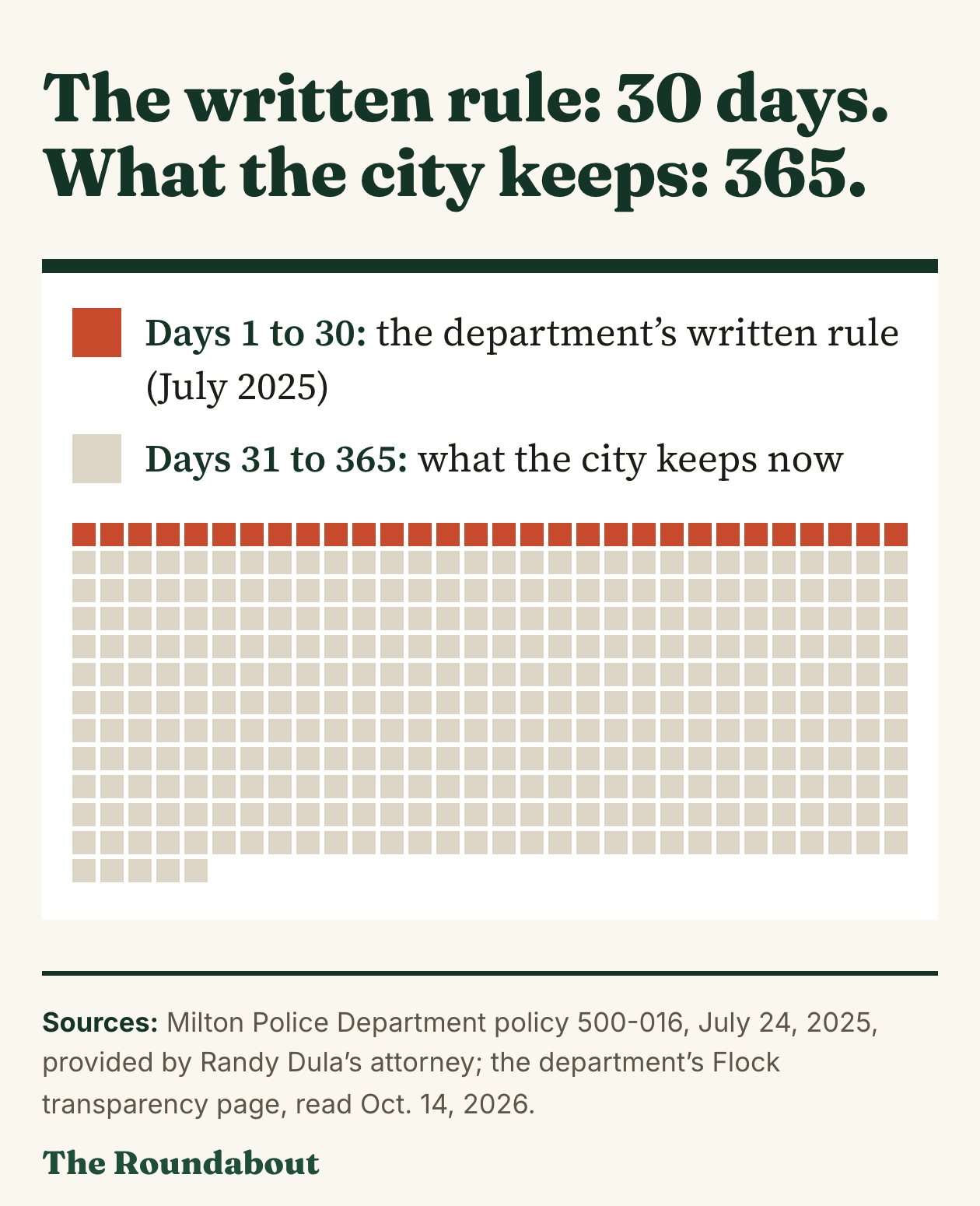
Say you drove past one of the cameras on the way to Thanksgiving dinner last year. Under the written rule, that record would have been deleted by New Year’s. Under the city’s setting, it’s still there. So is every other pass since, and a year of them can show a pattern: which roads you take, and when.
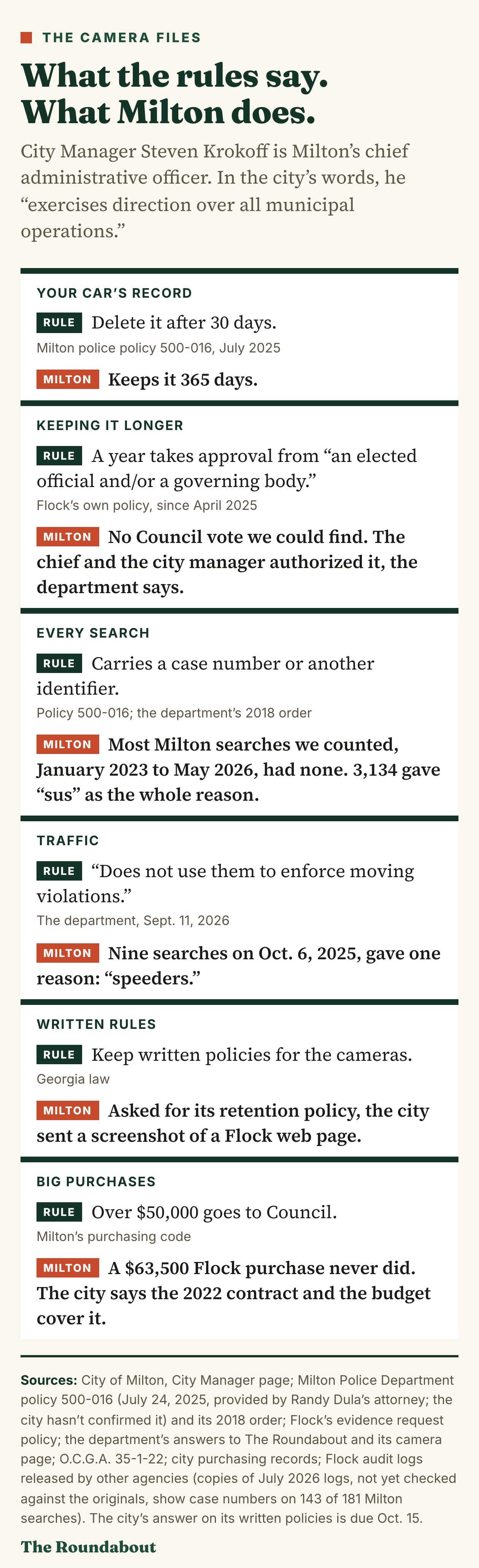
We found no Council vote on keeping it a year. The mayor says he “was not briefed” and calls decisions like that “operational ones.” And Flock’s own rules say keeping data that long takes the approval of an elected official or a governing body.
Two people made the call, the department says: Police Chief Jason Griffin and City Manager Steven Krokoff, a former Milton police chief who named Griffin to the job. Neither is elected. Krokoff also decided Dula’s final appeal, the lawyer says. On Oct. 2, he declined all 44 of our questions.
The city manager’s three obligations
City Manager Steven Krokoff appears in every thread of this story, and he knows the department from the inside. He was Milton’s police chief until 2016, when the City Council made him city manager, which the city describes as its chief administrative officer. When the previous chief resigned in December 2023, Krokoff named Jason Griffin permanent chief within days.
Before Milton, he joined the police department in Albany, N.Y., as a recruit in 1993 and rose to chief there. He became Milton’s police chief in 2015.
In Part 1, we showed a $63,500 Flock purchase that went past the city manager’s $50,000 limit and never went to Council.
When he declined our questions on Oct. 2, he named three obligations. “Reports of officers misusing these systems make those questions especially important,” he wrote. “Any use for private purposes is unacceptable and damages public trust. The technology’s value does not lessen our obligation to establish clear limits, provide documented oversight, and hold people accountable. Those responsibilities are central to our review of Milton’s LPR practices.” The city, he wrote, will “share any decisions resulting from our review when they are made.”
He made the city’s case for the cameras, too. Used in “a formal, documented police investigation and response,” they “have helped save lives and solve crimes, helped the police find missing children and vulnerable adults, located people in danger, and identified suspects in violent crimes.”
The record, in order:
- July 24, 2025: The department’s written policy sets 30 days of storage.
- October 2025: He and Chief Griffin authorize a year, the department says. We found no Council vote, and the mayor says he wasn’t briefed.
- Sept. 11, 2026: The department says two matters of “potential misuse” remain under investigation. By then, Bouziane and Dula had both left the department.
- Oct. 2: He declines all 44 of our questions, writing that “Any use for private purposes is unacceptable.”
- Oct. 14: Dula’s attorney tells us Krokoff decided Dula’s final appeal. The city’s attorney won’t forward our letter to Dula, and the city doesn’t answer our questions by our deadline.
The department told us Sept. 11 that every search must carry “the required case, CAD or purpose information,” meaning a case number, a 911 dispatch call number or a stated reason. Its 2018 order required a case number on every search, and its July 2025 policy requires a case number or another identifier; neither lists a typed reason. In August, Flock itself said it would “require case codes for all law enforcement searches by the end of the year.”
The department’s new public page gives a count of search sessions, but no list of searches. As of Oct. 12, Alpharetta’s and Johns Creek’s police pages offered a downloadable list of the last 30 days of searches, with a reason for each.
The department called both matters “potential misuse,” and its July 2025 policy calls misuse “a violation of state law.” GCIC, the state office that runs Georgia’s criminal records systems, said as of Oct. 1 that it had received no report from the department of a possible violation. The Fulton County District Attorney’s office didn’t answer our questions, sent Oct. 2 and Oct. 9, about any referral from Milton.
Officer of the Year, then terminated
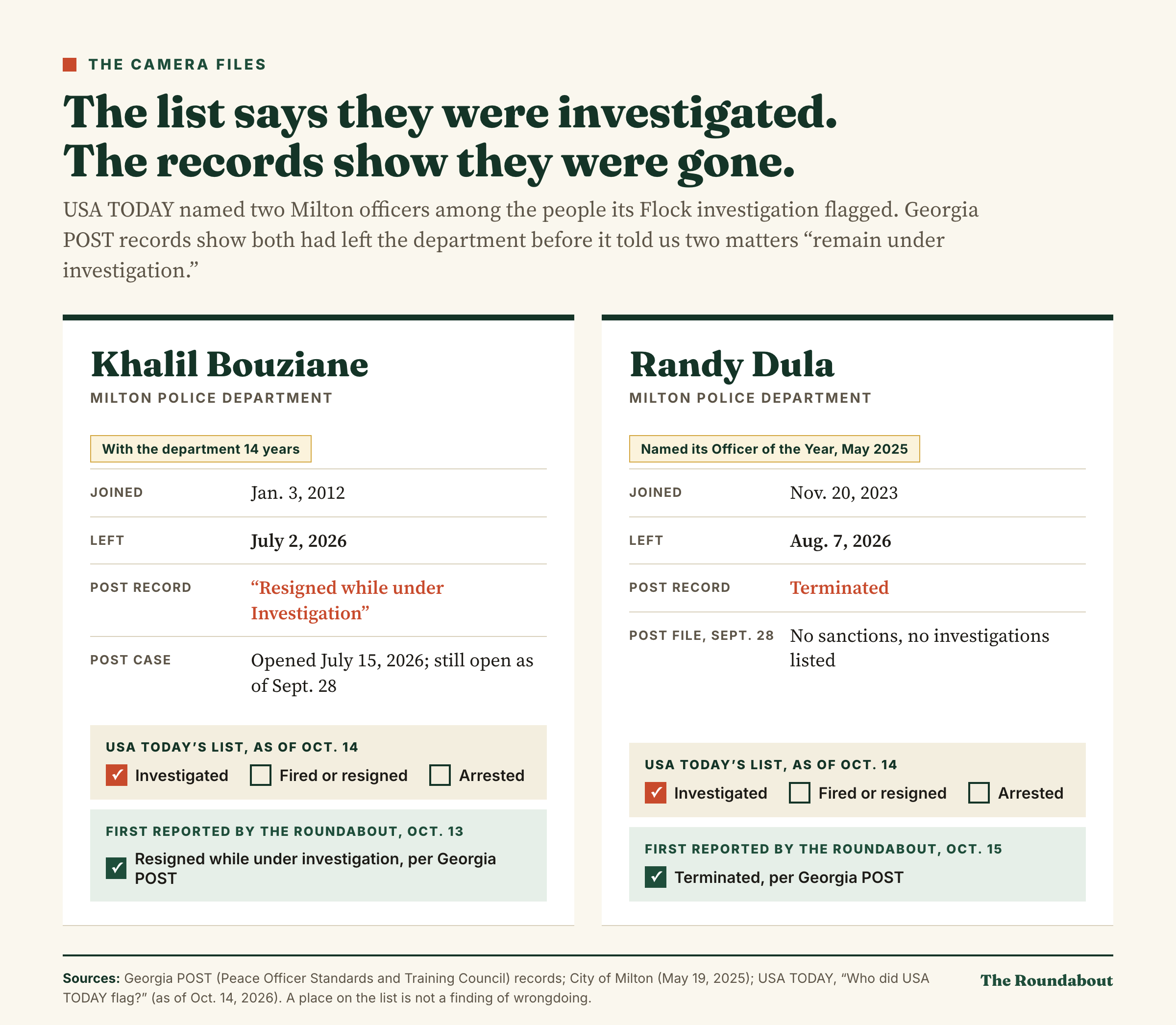
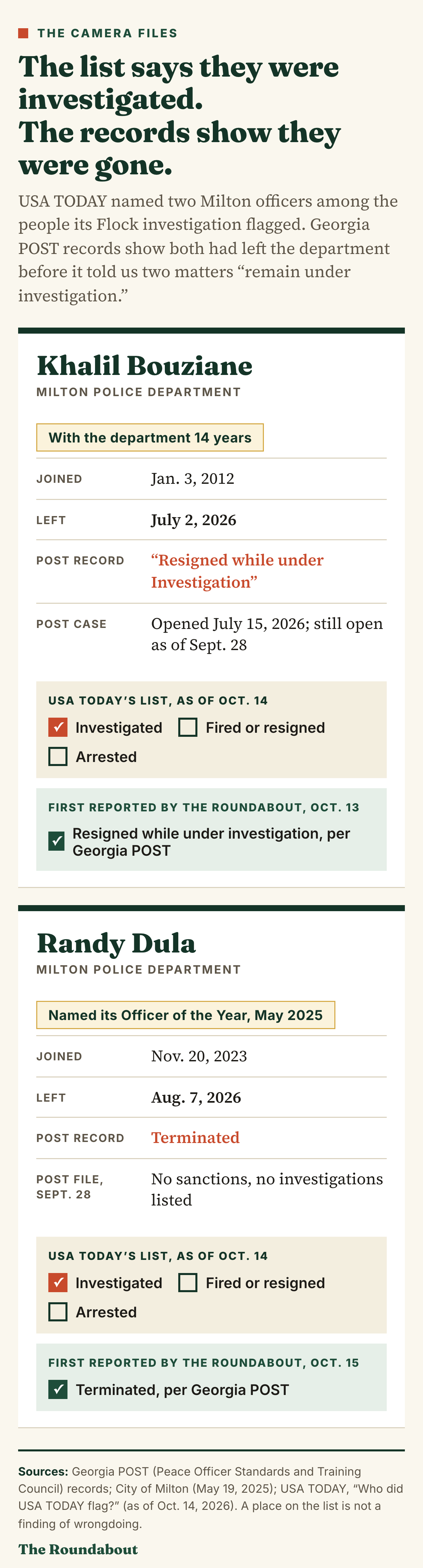
On Sept. 11, Milton’s Police Department told us in writing that it had “reviewed search activity and identified two matters that warranted further investigation as potential misuse. Both matters remain under investigation.” On Tuesday, we reported that the other Milton officer on USA TODAY’s list, Khalil Bouziane, had resigned 71 days before that statement, “while under Investigation,” in the words of his state record. An investigation can continue after an officer leaves, and being on USA TODAY’s list isn’t a finding that anyone broke a rule or the law.
Dula joined the Milton Police Department in November 2023. In May 2025, the department named him, then a detective, its Officer of the Year; the city’s announcement called him “a model of Milton Police’s vision and values.” In March 2026, the Alpharetta Lions Club named him the department’s Outstanding Officer of the Year. In May, the department gave him a ribbon for finishing a three-part leadership program.
The city’s announcement quoted Deputy Chief Chris Ward saying Dula often “goes above-and-beyond to solve cases that initially seem impossible.” After the Lions Club award, the department told its Facebook followers that “the results speak for themselves.”
Records kept by Georgia POST, the state agency that certifies police officers, show the department terminated him on Aug. 7, less than three months after that ribbon. That was 35 days before the department told us both matters remained open. As of Sept. 28, POST’s file on him listed no sanctions and no investigations, and POST’s records mark his separation as needing no file review. “File review required usually means the officer has a POST case,” a POST records officer told us.
The city and its police department publicized his honors three times, in two city news releases and a department Facebook post. Neither has said in a news release or on the department’s Facebook page that he, or Bouziane, left. The city’s first acknowledgment to us that Dula left came Wednesday, when its attorney called him a “former employee” in a letter declining to forward our letter to him.
What his attorney says
Skandalakis contacted us Wednesday, the day after Part 1 ran. Dula declined, through him, to be interviewed on the record. In his statement, Skandalakis wrote that Dula “served his country with distinction in the armed forces and then served his community as a police officer,” and that “had he not found her on multiple occasions when he used FLOCK, she would have died.”
He called the internal affairs process “a Kangaroo Court” and wrote: “The men and women who serve in the Milton PD need to be very aware that the department and their hierarchy Do Not Have Their Back.”
In an interview, Skandalakis said the department knew about her condition and knew her car’s plate. He said the case went to an internal affairs hearing (internal affairs is the office that investigates complaints about officers), that Dula’s wife attended but wasn’t allowed to speak, and that City Manager Steven Krokoff decided Dula’s final appeal. Dula will take his case to Superior Court with a new attorney, Skandalakis said, and the two plan a news conference Tuesday at Skandalakis’s law office. We found no court case under Dula’s name in Fulton County’s records as of Wednesday.
The department’s written rules on plate readers have said since at least 2018 that the data “may only be accessed for a legitimate law enforcement purpose.” Nothing we have says which part of its rules, if any, the department cited in firing Dula. His attorney’s word is “use.” We asked the city Wednesday afternoon about his account.
How it came out
USA TODAY keeps a list of the people its reporting on Flock, the company that makes Milton’s cameras, has flagged. As of Oct. 14, it counted 32 people nationwide, 12 at Georgia agencies. Two are Milton officers: Khalil Bouziane and Randy Dula. The paper says the agencies on its list launched investigations, suspended or fired officers, or filed charges after it asked about their employees’ “unusual Flock search patterns.” It marks both Milton officers as investigated, and neither as fired, resigned or arrested.
The list doesn’t say what either officer searched, or why. The department says its own review of search activity turned up the two matters. USA TODAY reported on Aug. 28 that Milton was among the agencies that “launched criminal or administrative investigations into officers because of USA TODAY’s reporting.” State records show both men had left by then.

How 30 days became 365
Georgia law requires police departments that use plate readers to have written policies for them. The department’s new public web page on the cameras says so but doesn’t post the policies.
Skandalakis sent us one on Wednesday: Milton Police Department policy 500-016, “License Plate Reader Systems,” issued to all personnel and in effect July 24, 2025. It says the data “will be stored on the vendor’s secure server for up to thirty (30) days. After thirty (30) days of storage, the information collected by the LPR System will be auto-deleted.” LPR stands for license plate reader. You can read the full six-page policy.

The city hasn’t confirmed the copy. Much of its text matches, word for word, the department’s 2018 order on plate readers, which the city released in 2019. We haven’t seen the version it replaced, from November 2022.
Thirty days is also what the 2022 contract Council approved for nine cameras said. About two months after the policy’s date, the department asked to buy a year of storage; the city’s purchase order, its written promise to pay, is dated Oct. 1, 2025. We found no Council vote on keeping the data longer in the agendas and minutes Council has posted since 2021, and the mayor, Peyton Jamison, said Monday he wasn’t briefed on the move to 365 days. The department’s page now says the data is kept 365 days.
Flock’s own rules say that kind of change needs an elected official’s sign-off. Since at least April 2025, the company’s written evidence policy has said it “will offer an extended retention for up to one year, but shall require the agency to first obtain approval from an elected official and/or a governing body.” In August, Flock’s chief executive, Garrett Langley, wrote that existing customers would keep their “democratically approved retention periods.”
Milton’s mayor puts that decision with the police. In his answer to us this week, he wrote that “how long data is kept, is the kind of judgment we rely on our Chief of Police and our department to make.”
The department told us in September that Milton’s year was authorized by the police chief and the city manager. The department has also pointed to the city’s budget book, which Council adopts. Its one line on this mentions extending data retention but gives no number of days, and the version posted online carries a December 2025 date, after Council voted on the budget. It said Milton’s switch predated Flock’s August 2026 guidance, but the approval rule was already in Flock’s policy six months before Milton made the change. When we asked Flock in September how Milton’s longer storage was approved, the company didn’t respond.
In September, we asked the city in a records request for any written policy documenting how long it keeps the data. It gave us a screenshot of a Flock web page that said 365 days, not policy 500-016. A second request, for the department’s written policies on the cameras, is due Thursday. On Wednesday we asked the city whether 500-016 is still the department’s policy, whether it has changed since July 2025, and why it wasn’t produced.
Every search, the policy says, must carry “a corresponding case number or other unique identifier such as outside agency case number, BOLO number, etc.” (A BOLO is a “be on the lookout” alert.) It also says “Misuse of LPR data is a violation of state law, GCIC Council Rules, and city policy. Any person misusing LPR data is subject to civil and criminal penalties under state law in addition to termination of employment under city policy.”
The six-page policy doesn’t mention sharing Milton’s data with other agencies. It makes a sergeant responsible for “oversight of LPR equipment” and for compiling “the monthly LPR reports.” We asked for those reports on Oct. 5; the request is pending.
How far a Milton search reaches
The department’s new public page lists 391 organizations with access to Milton’s camera data, from Georgia police departments to the FBI.
Every Flock search leaves a line in a running record called an audit log, and a search that reaches another police agency’s cameras shows up in that agency’s log too.
On Tuesday we reported that from January 2023 through May 2026, about nine in ten Milton searches in the logs other agencies have released showed no case number. The share may have risen this summer: a third party has posted copies of Milton’s July 2026 logs, which we haven’t checked against the original files, and they show case numbers on 143 of 181 searches.
Two departments’ complete records show how far many Milton searches reach. Florence, Ky., and Cheshire, Conn., each released every search other agencies ran on their cameras from Oct. 1 to Nov. 29, 2025. Each shows more than 1,000 Milton searches in those 59 days, and every one of them checked more than 2,000 camera networks across the country at once, some more than 6,000. (Each agency, business or neighborhood that shares its Flock cameras counts as a network.)
On Oct. 6, 2025, nine of those Milton searches gave one word as the reason: “speeders.” The same nine appear in both departments’ records, run within nine minutes that morning. The department told us Sept. 11 that it “does not use them to enforce moving violations,” and its public page, posted this month, lists “traffic enforcement” among prohibited uses. The log says nothing more about what those nine searches were for.
These counts come from searches that reached other agencies’ cameras, and they show what was typed into Flock, not what’s in the department’s own files. We sent the department our counts of the typed reasons on Oct. 9. It hadn’t responded by our deadline, noon Wednesday. We asked the city about the “speeders” searches Wednesday afternoon.
Before Dec. 18, 2025, when Flock began recording a category of offense instead of a typed reason, 3,134 Milton searches gave “sus,” shorthand for suspicious or suspect, as the entire reason. Another 2,877 gave only a two-digit number. The most common, “38,” stands for illegal drugs on a user-submitted list of Alpharetta and Milton police radio codes.
The department’s new camera page
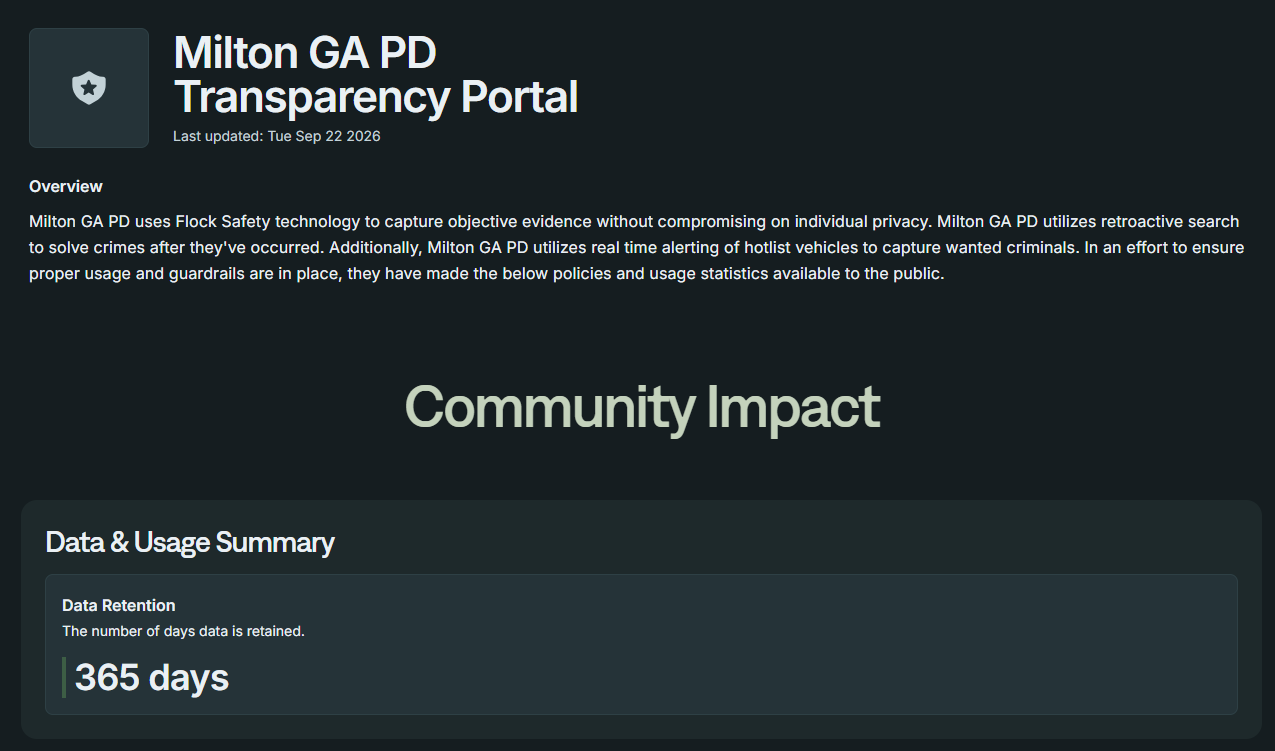
Sometime between Oct. 5 and Oct. 8, the department put up a public Flock “transparency portal,” which its website now links to. It had told us on Sept. 18 that it was evaluating one. We found no announcement and reported it on Oct. 11. The page lists 36 cameras, data kept 365 days and, as of Wednesday, 98 search sessions in the last 30 days.
On sharing, the department told us Sept. 18 that it had recently limited Milton’s data to “law enforcement agencies within the State of Georgia.” The page says Georgia agencies “and with federal partners who operate in the State of Georgia.” Its list of the 391 organizations granted access includes “[Federal] Indiana HIDTA” (HIDTA is a federal anti-drug program) and “Puerto Rico live cameras.” The page doesn’t explain either entry.
How other departments handled it
On Tuesday we told you about Athens-Clarke County, where police fired an officer this month for using Flock to search his ex-girlfriend’s plate, named him and said what he did, with the GBI investigating.
In Franklin County, N.C., Sheriff Kevin White announced in September that an audit had caught one of his detectives using the county’s Flock system to track a private citizen. He fired her, sent the findings to the district attorney, suspended the county’s cameras while past searches are reviewed, and said all of it in a public Facebook post. “No one is above the law,” he wrote, “especially not those who are trusted to enforce it.”
Dula’s attorney describes a different kind of case: searches for his wife’s car during her medical emergencies. The city hasn’t said what either Milton case involves. Both of those departments told the public what happened. Milton’s department hasn’t announced that either officer left. It told us Sept. 18: “Because those matters remain under investigation, the Department cannot provide additional details regarding the allegations, or investigative steps.”

Who decides
In September we asked readers who should decide how long Milton keeps its camera data. Of the 46 who answered, 26 picked City Council, in a public vote, and 14 picked state law. Three picked the police chief and city manager. The department says those two made the decision. (It isn’t a scientific poll, just the readers who tapped.)

On Monday, Mayor Peyton Jamison answered the three questions we sent on Oct. 5 to him and each councilmember. As we promised Tuesday, here is his answer in full. No councilmember had answered those three questions by Wednesday evening.
In fullMayor Peyton Jamison’s answerHis Oct. 12 email to The Roundabout, word for word
Mr. Hall, thank you for reaching out.
Automated license plate reader (ALPR) technology isn’t new to the City of Milton. The City installed its first ALPRs in 2011, and Council approved our first Flock branded camera in 2019. Across multiple City Councils, the policy has continued: Milton uses this technology to help protect residents.
In February 2022, Council approved nine additional cameras alongside the existing one, under a 24-month agreement with 30-day data retention. I understood that vote as continuing a long standing policy, with that agreement as the next stage of the program.
Since then, the program has grown to 36 cameras, and data is now retained for 365 days, within the limits of Georgia law. I was not briefed on those changes. Decisions like these are operational ones. City Council sets policy, and this policy was first established over a decade ago. How the tool is deployed day to day, including how many cameras, where they go, and how long data is kept, is the kind of judgment we rely on our Chief of Police and our department to make.
I support this program because I’ve seen firsthand how effective it is. But a tool this powerful only works if residents can trust it. Every search should be logged and auditable, and anyone who misuses this system, including our own officers, should be held accountable to the fullest extent of the law. I have confidence in our Chief to hold the department to that standard.
Peyton
Their side
Bouziane didn’t respond to the certified letter we mailed him in late September asking about the investigation and inviting his comment.
We couldn’t find contact information for Dula. On Oct. 8, we left a letter for him at the Milton Police Department and asked the department to forward it, and we repeated the request by email on Oct. 9. On Wednesday, the city’s attorney, Ken Jarrard, wrote that the city would not forward it and would return it unopened. Among his reasons, he wrote that forwarding it “could create confusion about whether the City is requesting or encouraging a response from Mr. Dula.” He also cited federal rules on private letter carriage, which he wrote “do not require the City to provide this service.” Those rules are exceptions that allow a letter to be carried without pay, which is all we asked. About an hour before his letter, Dula’s attorney had contacted us. His account is above, under “What his attorney says.”
The city didn’t respond to our Wednesday questions by our deadline, 9 p.m.
What we still don’t know
The city can answer most of these:
- what the department found in either case, and whether it disputes Dula’s account of his searches
- whether Bouziane’s investigation is one of the department’s camera matters
- when the department’s review began, and whether that was before or after the two men left
- whether either case went to prosecutors
- what POST’s case on Bouziane concerns
- whether the July 2025 policy is still the department’s rule, and if not, what replaced it
- what the city’s review of its plate reader practices will change, and when it will tell you
His lawyer says Dula found his wife because the cameras had recorded her car going by. They record yours, too. The department’s policy dated July 2025 says that record is deleted after 30 days. Its public page says the city keeps it 365.
Next in The Camera Files: the city manager’s own emails about the cameras, released under the Open Records Act.
How we reported this. The Roundabout has reported on Milton’s license plate cameras since Sept. 10. This story draws on records we obtained from Georgia POST and the City of Milton through open records requests; the Police Department’s Sept. 11 written answers to our questions, published in full at readroundabout.com/flock-cameras; the City Manager’s Oct. 2 letter; the mayor’s Oct. 12 answer; the city attorney’s Oct. 14 letter; USA TODAY’s published list; Flock audit logs released by 27 agencies and by Florence, Ky., and Cheshire, Conn.; answers from the GBI; a Milton Police Department policy provided by Dula’s attorney; an interview with his attorney and his written statement; and reporting by WUGA and ABC11. Dula declined to be interviewed on the record. We have filed 27 open records requests about the camera program, 17 with Milton and 10 with other agencies in Georgia, Connecticut and Kentucky, and several are still pending.
This story ran in Issue #71. The Roundabout publishes three mornings a week, free, Milton-only, and the next one can be in your inbox.