
A sergeant signed for a year of your data. Council never voted.
Part 3 of The Camera Files: who chose a year of retention, what the city knew and what it told you, and what Milton paid.
New to the series? Read Part 1 and Part 2.
Milton now keeps the record of every car that passes its 36 license plate cameras for a year, and its police chief has signed an agreement putting Milton’s plate-reader data into a federally funded anti-drug program’s database. No one on the City Council voted on either, the city’s own answers to The Roundabout’s records requests show.
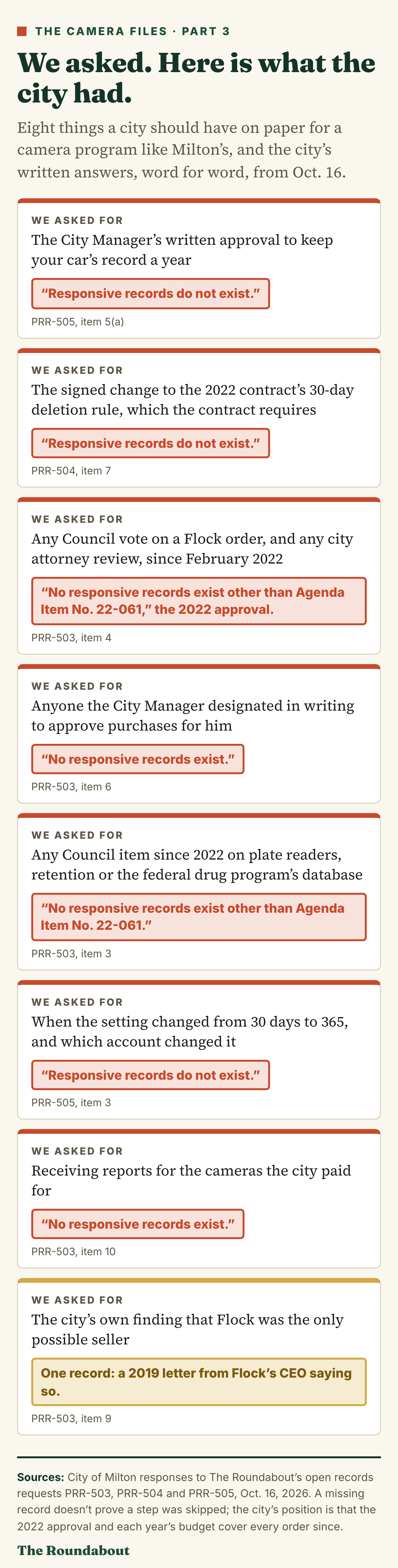
We asked Milton for one piece of paper: the City Manager’s written approval to keep the record of your car a year instead of 30 days.
“Responsive records do not exist,” the city answered on Oct. 16.
We asked for any Council vote, and any city attorney review, of a Flock camera deal since 2022. “No responsive records exist other than Agenda Item No. 22-061,” the city answered: the nine-camera approval of February 2022.
So we kept digging. We filed 31 records requests with the city. We read every city budget since 2021, about 1,700 pages, and searched the record of 38 budget meetings. We went through the city’s own accounting books and the emails it has released. Here is what they show.
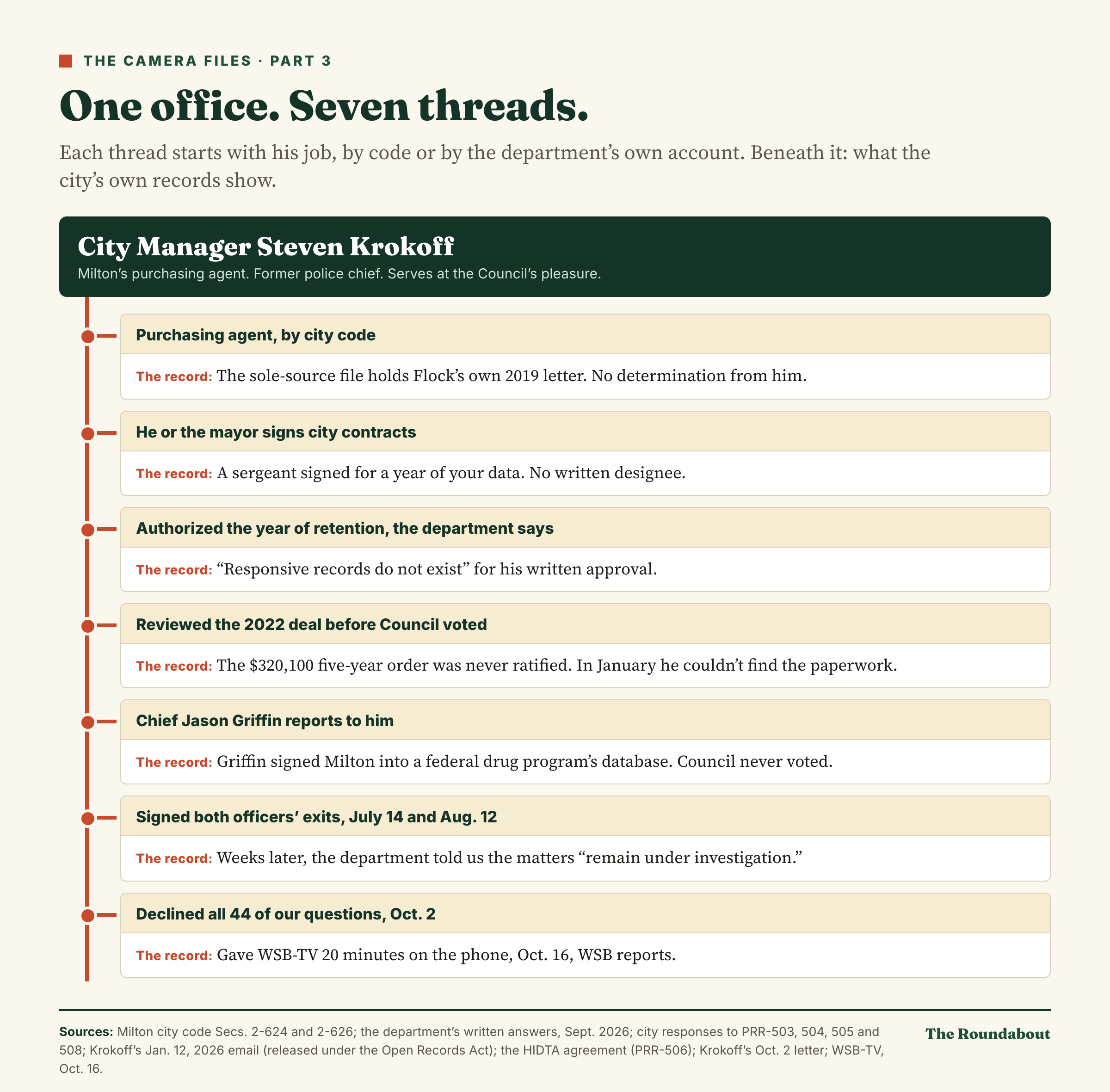
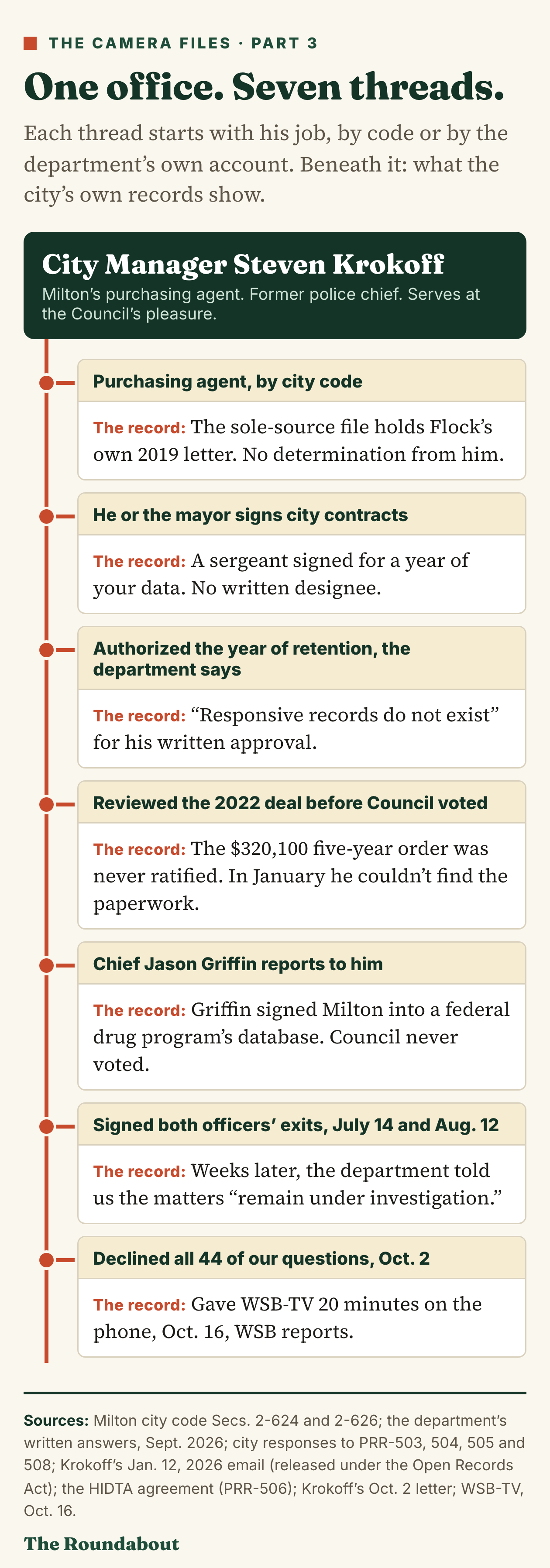
Almost every finding in this story runs through one office: City Manager Steven Krokoff’s.
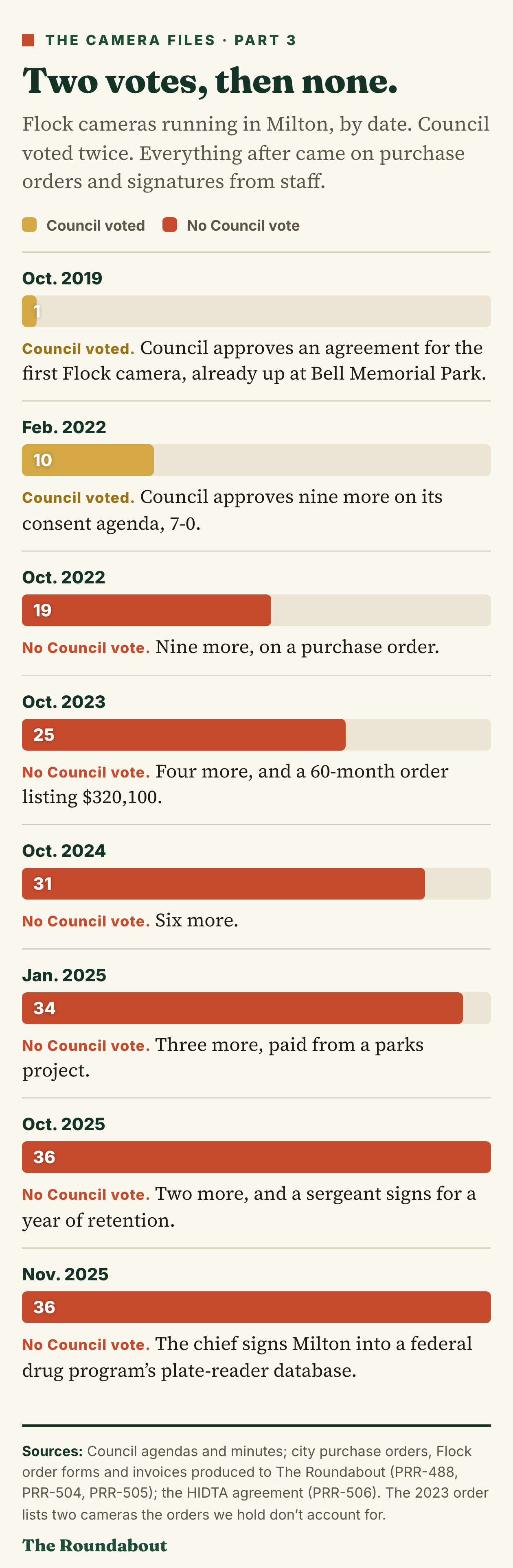
Say you drive past one of Milton’s 36 cameras on the way to school pickup. Under the deal Council approved in 2022, the picture of your car would be deleted in 30 days. Today the city keeps it a year. And since November, the police chief has agreed to share Milton’s camera data with a federal anti-drug program that pools it with agencies across the region.
Nobody you elected voted on any of it. Here is who decided.
The city manager is in charge of all of it
City Manager Steven Krokoff is not a bystander to any of this. Milton’s city code makes him the city’s purchasing agent: “The city council hereby appoints the city manager or his or her agent to serve as the purchasing agent.” That job covers every city purchase and contract, the monthly reports on them and the public file of no-bid purchases. Asked for those records on Flock, the city produced one line from a 2022 contract log and Flock’s own letter.
He knows the department from the inside. Krokoff was Milton’s police chief before Council made him city manager, and he named Jason Griffin chief.
He reviewed the 2022 deal, the nine-camera, two-year Flock agreement, before Council voted on it. The Charter lets Council delegate to him contracts worth up to $50,000 within one budget year, ratified afterward, and the city code lets him approve budgeted purchases up to $50,000 without Council. The order that followed listed $63,500 a year and a $320,100 total. Council never ratified it.
He authorized your car’s record being kept a year, the department says. The city has no written approval from him.
In January he went looking for the paperwork behind the five-year deal and wrote, “I have not been able to locate anything on my end.” The city’s audit was signed two months later. The records released so far don’t show he ever found it.
He signed off on both officers’ exits: Officer Khalil Bouziane’s resignation on July 14, and Randy Dula’s firing on Aug. 12, records show. A month later, on Sept. 11, the department told us both of its Flock misuse matters “remain under investigation,” and it said so again on Sept. 18. (Its own rules let an internal investigation continue after an officer leaves.) On Oct. 2 he turned down all 44 of our camera questions, saying they needed “more research, coordination, and legal review than staff can sustain.” The same letter says the city has an “obligation to establish clear limits, provide documented oversight, and hold people accountable.” On Oct. 16, WSB-TV reported, he spent 20 minutes on the phone with its reporter.
The Roundabout
Get The Camera Files as the records come in
We've filed 31 records requests with the city. What comes back runs in The Roundabout: free, Milton-only, Tuesday, Thursday and Sunday at 7 a.m.
Already a subscriber? Use the same email and we'll recognize you. We never sell your address.
What the city knew, and what it told you
The department has never said publicly who its two Flock misuse cases involve. USA TODAY’s national list of officers flagged for unusual Flock searches names two from Milton: Khalil Bouziane and Randy Dula. Here is what the city’s own personnel forms, produced to us this week, show about them, beside what the city said.
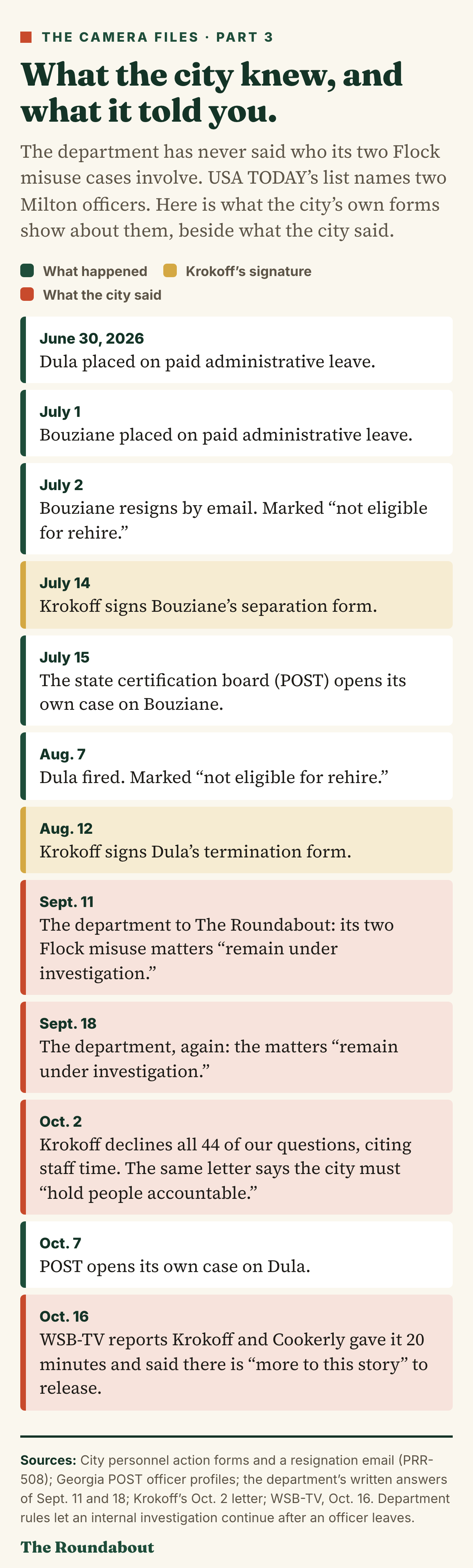
The department’s own rules let an internal investigation reach a finding after an officer leaves, so a case can stay open on paper. But by Sept. 11, both men were gone, both were marked “not eligible for rehire,” and the city manager had signed off on both. The city didn’t say so, and we found no city announcement of either departure. The Roundabout reported Bouziane’s resignation on Oct. 13 and Dula’s firing on Oct. 15, from state records.
The comments on each form are blacked out, with no legal citation for withholding them.
Who signed for a year of your data
The department told us in September that the Chief and the City Manager authorized keeping your car’s record a year.
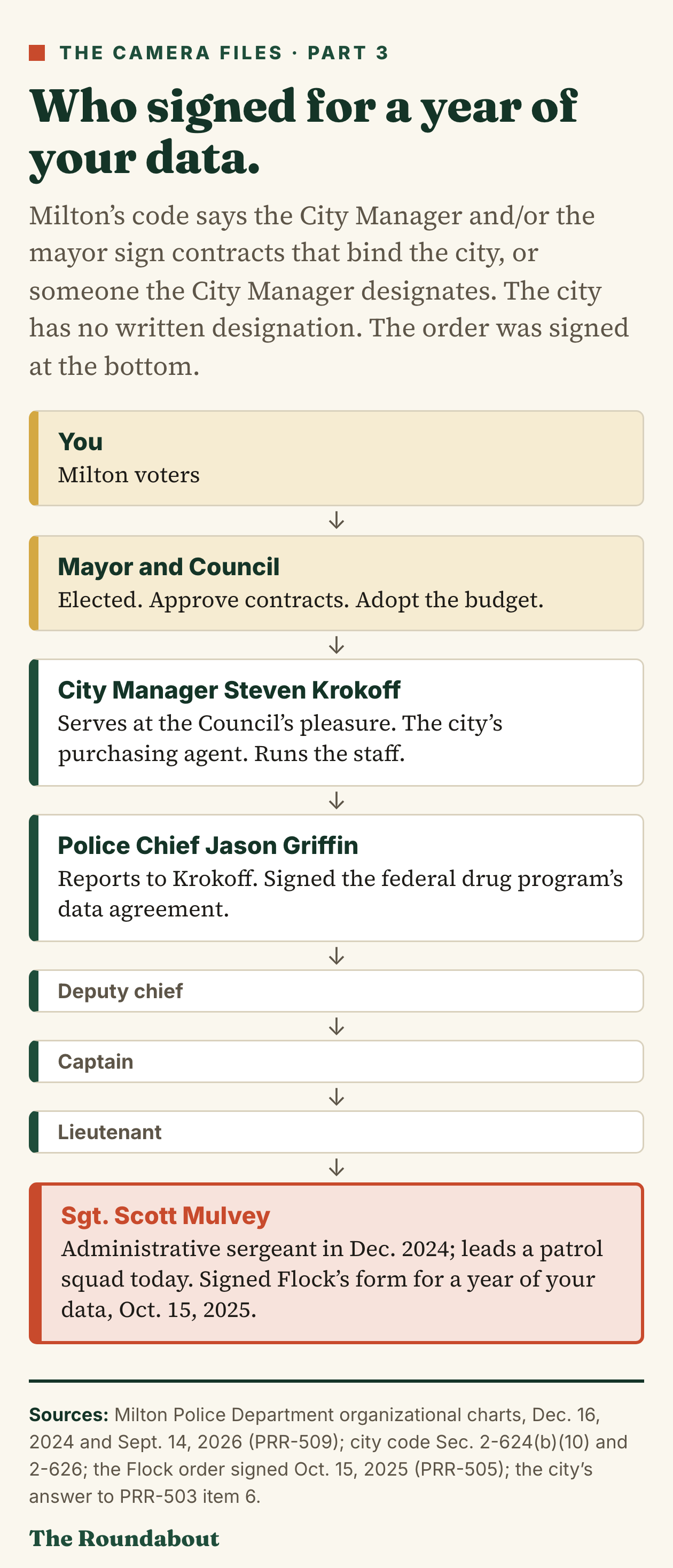
The order that did it, a 24-month, $32,400 Flock order for 365-day retention, was signed for “GA - Milton PD” on Oct. 15, 2025, through Flock’s DocuSign. The signature is Sgt. Scott Mulvey’s. A second sergeant signed a no-cost change in June. No line on the order is signed by the Chief, the City Manager, the mayor or the City Attorney, though the city’s purchase request for it carries Chief Griffin’s electronic approval, as Part 1 reported.
Mulvey is the department’s main contact with Flock. Flock’s 2019 “sole source” letter is addressed to him, he is the named contact on the 2022 order form, and a Flock invoice lists him as the billing contact. In December 2024 the department’s chart listed him as its administrative sergeant in Support Services; today he leads a patrol squad. Either way, he is not command staff.
We asked for the City Manager’s written approval. “Responsive records do not exist,” the city answered. We asked for the signed change to the 2022 contract, which said footage is deleted after 30 days and can be changed only in a signed writing. “Responsive records do not exist.” The same day, it produced the sergeant-signed order form; it didn’t say whether it counts that as the signed change.
Flock’s senior customer success manager told Mulvey on Sept. 25 of this year that the signed contract “is the only ‘form’ needed.”
That’s Flock’s paperwork talking. A vendor’s form doesn’t set Milton’s rules; Milton’s laws do. The city’s purchasing code says who may sign: “The city manager and/or mayor shall approve final contracts and execute and bind the city to such agreements.” The code lets the City Manager act through a designee. We asked for any written designation. “No responsive records exist.”
Here is the chain of command, from the department’s own chart: Mulvey reports to a lieutenant, who reports to a captain, who reports to a deputy chief, who reports to Chief Griffin. Griffin reports to City Manager Krokoff. Krokoff serves at the pleasure of the Council you elect. The signature on your data is at the bottom of that chain.
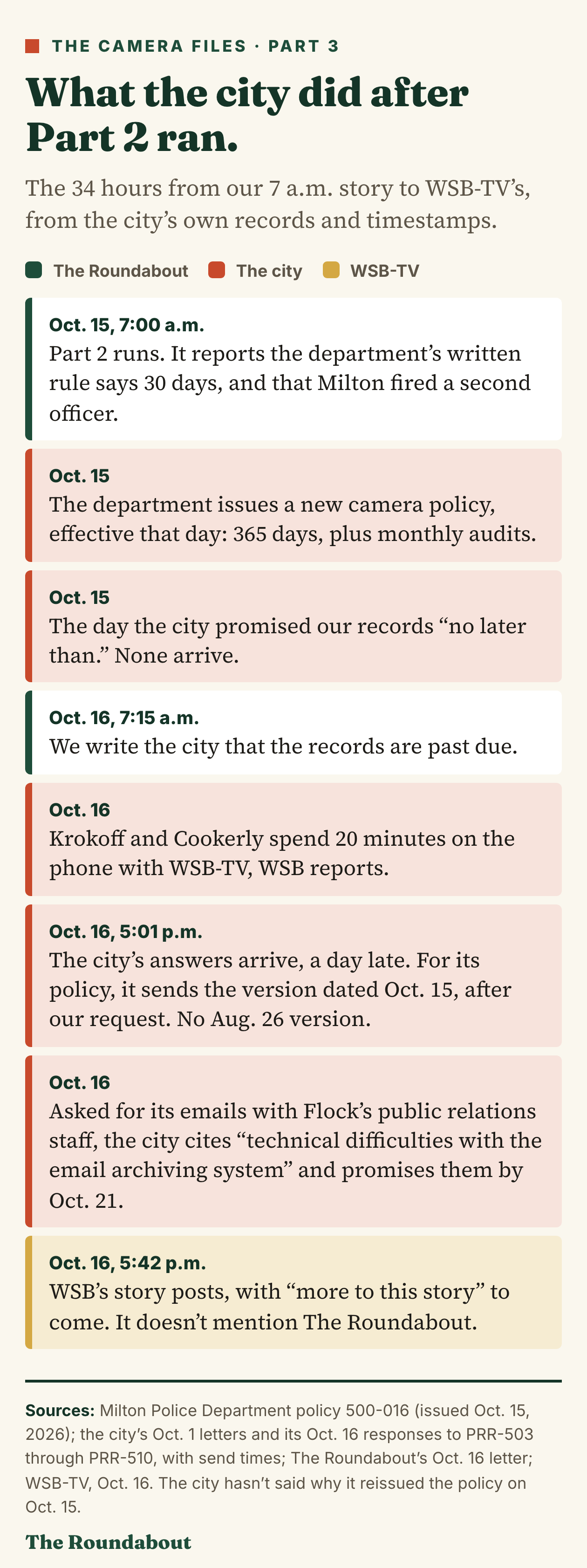
The department’s written rule said 30 days for at least 10 months after the change. We started asking about the gap in September. On the morning of Oct. 15, Part 2 reported it. That same day, the department issued a new version of the policy. It says 365 days, and it adds what Part 2 found missing: monthly audits by a three-member team, a deputy chief, a captain and a sergeant. The city hasn’t produced the version in between, dated Aug. 26, 2026.
The new policy is silent on one thing. It never mentions sharing Milton’s camera data with another agency, or the federal drug program the chief signed Milton into 11 months earlier. The rule that is supposed to govern your data doesn’t say who else can search it.
Keeping plate data a year is legal in Georgia, where the general limit is 30 months. The department says it chose a year because “relevant vehicle information may not emerge within seven or 30 days.” Flock’s own policy, since at least April 2025, requires the approval of “an elected official and/or a governing body” before data is kept that long. Council never voted on it.
One set of rules for officers
The department’s new policy warns every officer that anyone “misusing LPR data is subject to civil and criminal penalties under state law in addition to termination of employment under city policy.” Both Milton officers named on USA TODAY’s list are gone. One was fired. The other resigned under investigation. Dula’s lawyer says he searched the cameras to find his wife during medical emergencies, as Part 2 reported. The city blacked out the comments on both men’s forms, so it hasn’t said which rules each was found to have broken.
Now hold the department to its own paper. Its written rule said delete your car’s record after 30 days. For at least 10 months, it kept the record 365. Flock’s own policy called for approval from “an elected official and/or a governing body.” Council never voted. The city’s purchasing code says the City Manager or the mayor approves contracts. A sergeant signed. The Charter says the city attorney reviews contracts. The city has no record he saw this one.
Chief Griffin runs the department, and the purchase request for the year of retention carries his electronic approval. City Manager Krokoff authorized the year, the department says, and signed both officers’ exits. Two officers on the Flock list are gone. The two men in charge haven’t answered for the rules the department itself skipped. Krokoff declined our questions on Oct. 2. Neither he nor Griffin had answered the newest ones by publication.
Who else can search it
Three weeks after the year of retention began, Chief Griffin signed another agreement: a memorandum with the Atlanta-Carolinas High Intensity Drug Trafficking Area program, a federally funded anti-drug program that pools plate-reader data from member police agencies. He signed it on Nov. 6, 2025.
The agreement says: “The Governing Authorities of the Member Agencies enumerated herein have each authorized execution of this agreement.” In Milton, that’s the Mayor and Council. The city says Council has had no item about the HIDTA program since 2022. The city hasn’t said which cameras feed the database.
It also lets HIDTA bring in new partners on its own, with its own lawyer’s approval. Agreements adding “new member agencies or information sharing systems,” it says, “will not require further review or approval by Member Agencies.” Data sent to HIDTA’s server stays there for as long as state law or the department’s policy sets, or up to two years if neither sets a limit.
The department told us in September that the agreement shares “selected license plate reader data with our federal and state partners for legitimate law enforcement purposes,” that state patrol policy requires it for cameras on state highways, and that it “does not transfer ownership or control” of the city’s system or data. The agreement agrees on ownership: each agency stays “the official custodian” of what it contributes.
The state does attach a condition to cameras on state highways. Georgia DOT’s permit rules, in effect since October 2024, require a local police department to promise to make the data available “at no additional cost ... across the law enforcement community,” and GDOT “will revoke its permit” if it stops. Milton’s police made that promise in writing in February for a camera on Birmingham Highway. GDOT’s rules don’t mention HIDTA. The state patrol policy the department cites isn’t public, and the city hasn’t said which of its 36 cameras sit on state highways.
Whether a federal drug program should be able to search Milton’s camera data is a fair debate, and plenty of readers will welcome it. The agreement itself says who settles it: the city’s governing authority. That’s the Mayor and Council, and they haven’t voted.
What they said, and what the records show
It knew how. In October 2025, the same month a sergeant signed for the year of retention, the city renewed its facial recognition service, Clearview AI, for three years. That renewal went to Council with a staff memo, the mayor’s signature, the city attorney’s approval and the state’s annual-termination clause.
“Hold people accountable.” The department’s 2025 internal affairs report shows it disciplined Khalil Bouziane, then a detective: a two-week unpaid suspension and a year’s ban from extra-duty jobs, for “double-dipping” and leaving those jobs early “while still billing the employer.” He kept his job. In July 2026 he resigned while under investigation, state records show, and USA TODAY lists him among officers investigated over Flock searches. He didn’t answer the letter we mailed him in September.
Councilmember Carol Cookerly
Carol Cookerly, who represents District 1, was on Council for the vote that started the program. On Feb. 7, 2022, the nine-camera Flock deal came to Council as one of ten items on the consent agenda, the list approved in one motion without discussion. Councilmember Rick Mohrig moved it, Cookerly seconded, and it passed 7-0. On Sept. 18, 2023, every member present voted for the 2024 budget, 6-0, Mohrig on the motion. It’s the budget whose police maintenance line he had asked about a month earlier, at a work session Cookerly missed, and it says nothing about Flock.
On Sept. 9, the last person to speak at Milton’s City Council meeting came with records too. “I’m here tonight to talk about flock cameras in Milton,” said Lindsay DeFranco of Milton, the Democratic candidate for state House District 47 on the Nov. 3 ballot. She turned to Mayor Peyton Jamison. At a town hall, she said, a resident had asked him how many cameras Milton has, where they are and what happens to the data, “and you said you didn’t know.” Then: “I have the contracts, I have the invoices, and I have your signature.” (His signature is on the 2022 order for nine cameras. He told us Oct. 12 he was not briefed on the growth since.)
“Based on the records the city gave me, the system tripled in size with no public approval,” she said. “Now, I’m not accusing anyone of breaking the law.” Her ask: “So put the contract in front of us. Tell us how many cameras we have, where they are, who can access the data.”
“Okay, we’ll close public comment,” the mayor said, “and we will now move on to the consent agenda.” No one from the city answered her.
About an hour and a half later, during Mayor and Council reports, Councilmember Carol Cookerly did, from the dais. “We do not require accuracy at the podium,” she said. Speakers offer “quasi facts,” she said, “riddled with highly inaccurate information,” and “Flock takes the hit because it’s the known brand.” Anyone “running for office,” she said, “is absolutely irresponsible to go down this path.” And: “this person, whoever gets filmed periodically making these outrageous statements, has no trouble putting them out on social media, I assume. Certainly isn’t worried about privacy.”
Milton’s rules of decorum for Council members, Sec. 2-56 of the city code, say: “Personal remarks are inappropriate and may be ruled out of order.” The mayor enforces them, and any member may raise a point of order. No one did.
We checked what DeFranco said against the city’s own records. Milton’s first Flock camera came in 2019. Council approved nine more in February 2022 as one of ten items on its consent agenda, in a single 7-0 vote. By October 2025 the city ran 36, more than the “at least 27” she counted. She said Milton had paid Flock “more than $227,000”; the city’s own checkbook shows $341,235.62 paid to Flock by the time she spoke. And the 2022 agreement does give Flock, in its words, a “worldwide, perpetual, royalty-free right and license” to Milton’s data. Her numbers hold up.
When Cookerly defended Flock that night, she didn’t mention that she and Flock’s chief executive are both leaders of the Atlanta Police Foundation, a private nonprofit that raises money for Atlanta’s police department. The foundation’s website lists “Carol Cookerly, President, Cookerly PR, Communications Committee Chair” on its executive committee and “Garrett Langley, Founder & CEO, Flock Safety” on its board of trustees. The foundation itself has been Flock’s partner since 2021: it sells Flock plate readers to Atlanta businesses and neighborhoods for the city’s poles.
Langley joined its board of trustees in 2025, after the 2022 vote, archived copies of its website show. Milton pays the foundation nothing. Milton’s ethics code requires members to disclose a “financial or personal interest” in matters before Council; it doesn’t require them to list charitable roles. She hadn’t answered our question about it by publication.
Cookerly was one of six Council members who didn’t answer the three questions we sent the mayor and Council on Oct. 5; the mayor answered. On Oct. 16, WSB-TV reported, she joined Krokoff on a 20-minute call with its reporter about the officers and the cameras.
The Roundabout
More of the city's records are on the way
Get them in your inbox when we do. The Roundabout is free and Milton-only. No paywall, ever.
Already a subscriber? Use the same email and we'll recognize you. We never sell your address.
Who the city talks to
The Roundabout first reported Randy Dula’s firing on Oct. 15, in Part 2 of this series. Two weeks earlier, on Oct. 2, Krokoff had refused to answer our 44 questions.
On Oct. 16, Krokoff and Cookerly spent 20 minutes on the phone with WSB-TV reporter Bryan Mims, WSB reported, and said there is “more to this story that they will be able to release in the next couple of weeks,” in WSB’s words. WSB’s story, posted that evening, did not mention The Roundabout. We asked WSB for credit that day. WSB hadn’t added it by publication.
The city’s answers to our own records requests, filed in September and promised by Oct. 15, arrived the same afternoon, a day late, less than an hour before WSB’s story posted.
The city manager who said our questions were more than his staff could sustain found 20 minutes for a TV reporter.
What the budget told Council
Milton’s leaders have one answer to the question DeFranco asked. The city told us in September that Council “authorizes the funding through adoption of the annual budget.”
So we read them: every budget the city has adopted since 2021, plus the one up for a vote this fall. That’s about 1,700 pages.
The word “Flock” isn’t in any of them. Neither is a count of plate-reader cameras, a price, a contract length or a number of days.
Here is every line about plate readers, word for word, beside what the police department actually bought that year.
A budget book is the city’s printed plan for the year. Council adopts the spending in a vote each September.
The 2026 line is the only one that mentions keeping data longer. It doesn’t say how much longer. The online copy is dated December 2025, nearly three months after Council voted. Those plate-reader lines weren’t read aloud or shown on a slide at any budget meeting we searched.
We also checked what Council heard out loud. Staff present each year’s budget at work sessions, hearings and a workshop from spring to September. We searched the slides, the minutes and the video transcripts of about 38 of those meetings from 2022 to 2026.
In those meetings, staff never said “Flock.” The first time anyone said it, in the meetings we searched, was Sept. 9, 2026, when a resident stood up.
The police chiefs presented their budget priorities each summer from 2023 to 2025. In 2023, Chief Rich Austin asked for a school officer, two sergeants and a tethered drone. In 2024, Chief Jason Griffin asked for a detective on a regional task force and money to finish unused space at the police building; in 2025, for two more school officers. None of the requests was a plate reader.
The question at the budget meeting
On Aug. 14, 2023, Deputy City Manager Bernadette Harvill walked Council through the 2024 budget at a work session. The police department’s line for maintenance contracts was set to jump to $671,029, up 40.5% in a year.
“Can you um just go back one slide please,” Councilmember Rick Mohrig said, “and you just tell us a little bit more about the maintenance contracts.”
Harvill named two things: Milton’s share of the North Fulton regional radio system and a new records system the city shares with Alpharetta. Mohrig asked how much of the $671,029 those two items were.
“I can get you that exact dollar amount, I just don’t have it right here,” she said. “It is the majority of it.” She said she would bring the numbers back after the break. We found no follow-up in the rest of the meeting.
Flock wasn’t mentioned. Harvill may well have been right that the radios and records system were “the majority” of that line. But here is what the city’s own checkbook shows Milton paid Flock in that budget year, charged to a police account, the purchase order shows:
- Jan. 2, 2024: $22,500, a “subscription renewal.”
- March 5, 2024: $41,935.62, to “install (4) new safety cameras” and renew the rest.
That’s $64,435.62 in one year, more than the $50,000 the city manager may approve without Council. Council never voted on the order. Two months after Mohrig asked, on Oct. 16, 2023, the department placed a 60-month Flock order at $63,500 a year, listing a “Contract Total” of $320,100.
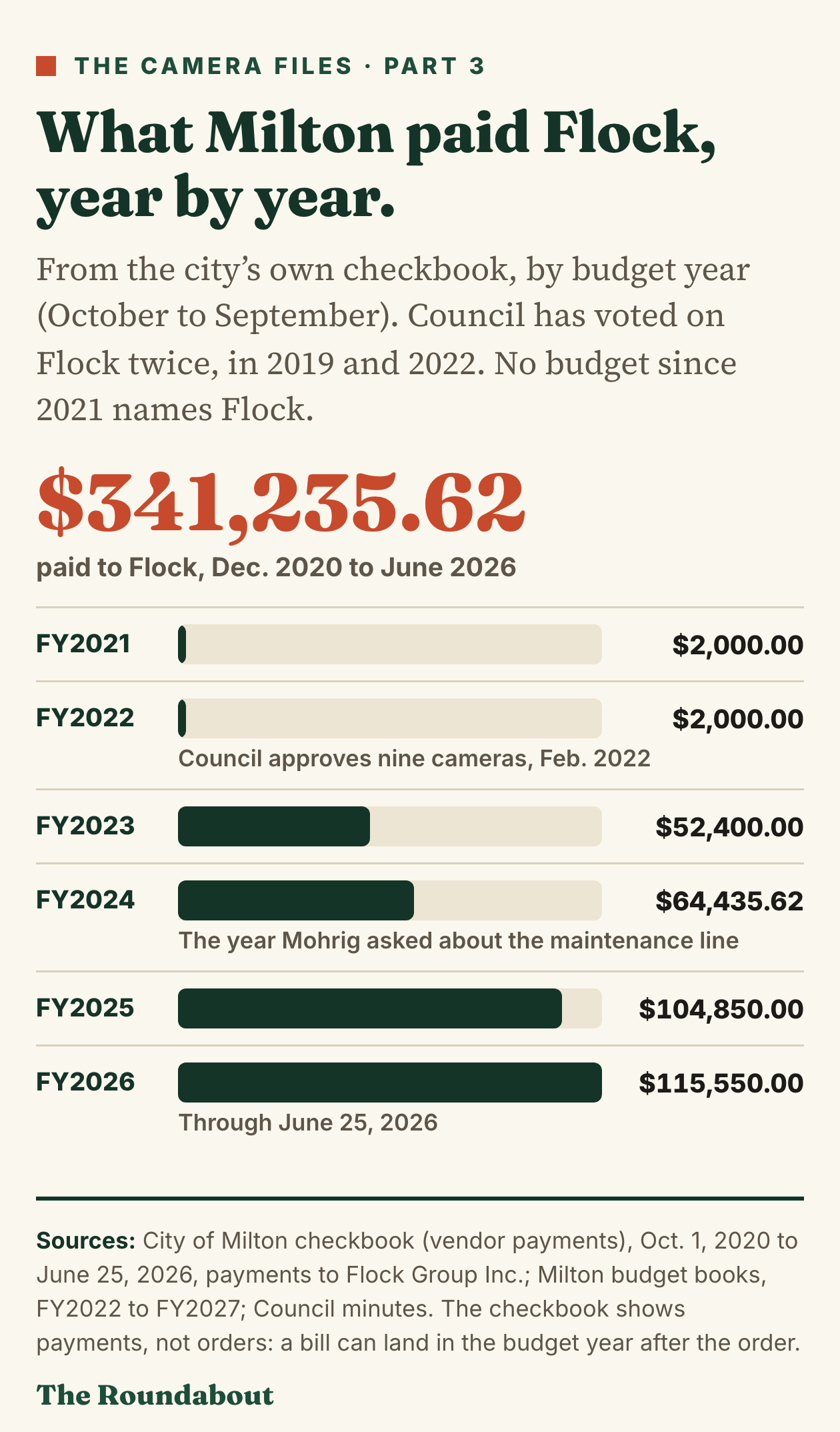
The city says Council approves Flock through the budget. It hasn’t said which line in the budget pays for it. The budget books never name Flock, and no city record we have says which police line carries it. We asked; the city hadn’t answered by publication.
How a two-year deal became five
Think of it like a phone plan. Milton doesn’t buy the cameras. It rents them from Flock, paying a yearly fee for each one, the way you pay a monthly bill for a phone. Flock owns the hardware.
Council’s 2022 vote covered nine cameras on a two-year plan, at $24,750 the first year.
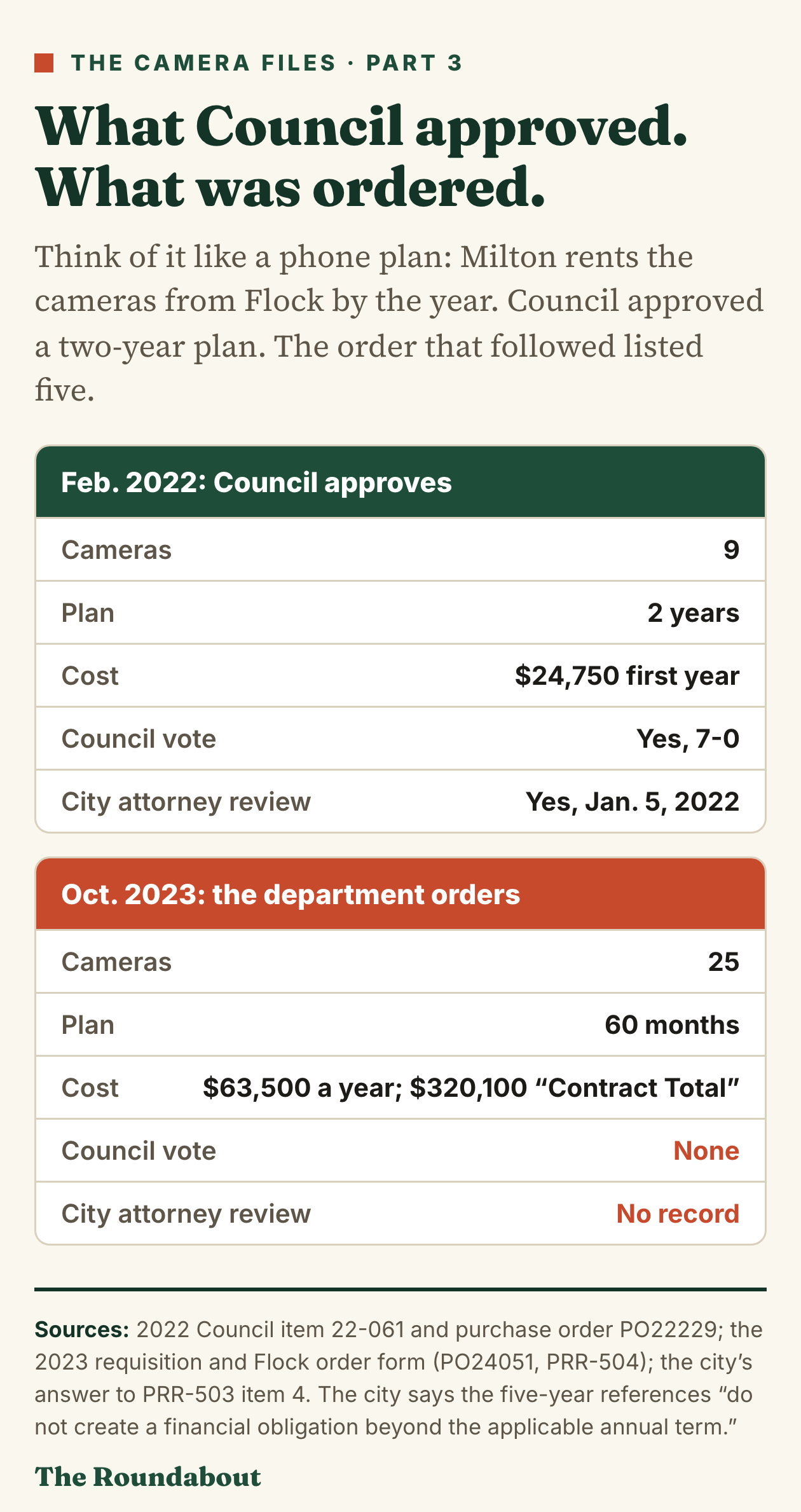
Then the plan changed. On Oct. 16, 2023, the department asked to spend $66,100 with Flock. The order behind it put 25 cameras, including four new ones, on a new 60-month plan. Five years, $63,500 a year, a $60,000 discount the form doesn’t explain, and a “Contract Total” of $320,100. Council didn’t vote on it.
The order form keeps the 2022 deal’s 30-day retention and renews on its own for 24 months at a time unless one side gives 30 days’ notice. It put every camera the city already had on one clock; Flock’s October 2025 bill for those 25 cameras reads “Co-Term: Year 3 of 60 Month Term.” Cameras added later run on their own 24-month terms.
It went on the requisition form for buys under $50,000 ($1,000 to $49,999.99). In the box for the purchasing method, someone wrote by hand: “Multi Year Contract (contract #22-02-14).”
Contract 22-02-14 is the city’s number for the nine-camera approval from February 2022. The five-year order was filed under the nine-camera vote.
The city’s bookkeepers treated it as a five-year plan, too. In the city’s list of software subscriptions for fiscal 2025, which it gave us this week, the Flock order is spread over five years: $297,012, counted down $59,403 a year. By Sept. 30, 2025, the city’s books showed $243,058 still to pay Flock across three Flock plans.
Here’s what that does and doesn’t mean. Georgia law lets a city walk away from a deal like this at the end of any year. But accounting rules say to write down the plan the city expects to keep, and Milton’s books spread this one over five years. That’s a plan, not a cage: the city could still leave. What the city didn’t do was bring a five-year plan to Council. The city told us in September that five-year references on Flock’s paperwork “do not create a financial obligation beyond the applicable annual term.”
Who signed the five-year order for the city? The city gave us the order form without a signature page.
City Manager Steven Krokoff went looking for the answer himself. On Jan. 12 of this year, working “through some items for the audit,” he wrote to Sgt. Mulvey and the city’s procurement manager, Honor Motes, copying Chief Griffin and Deputy City Manager Bernadette Harvill. The 2022 contract, he wrote, “appears to have an initial 24-month term followed by automatic annual renewals.” But a 2025 invoice “indicates we were in year 2 of 5, which I cannot reconcile with the contract language I am seeing.”
“This distinction affects how we treat the agreement for lease purposes,” he wrote, and he asked whether they knew of “any amendment, renewal, or other documentation that would support a five-year term. I have not been able to locate anything on my end.”
No reply appears in the city’s emails released under the Open Records Act, which run through Jan. 31, and the records released so far don’t show what the five-year figure rests on. The audit was signed two months later.
Other cities put the same kind of deal to a vote. In January 2024, Dunwoody’s staff asked its council to “Approve the Five-Year Contract for License Plate Readers with Flock Safety,” an $840,000 order.
The 2022 agreement includes an add-on, Addendum No. 1, which ends the deal each Dec. 31 under a state law for multiyear contracts, O.C.G.A. 36-60-13, and which the city says controls. If it governs, the city could walk away each December without paying the rest. If Flock’s standard terms govern, ending early costs a fee per camera. Part 1 reported that the city’s copy of that addendum is not signed by the city. We are asking the city which terms it believes control.
The Roundabout
Know what your city is deciding before it's decided
The Roundabout reads the records so you don't have to. Free, three mornings a week.
Already a subscriber? Use the same email and we'll recognize you. We never sell your address.
Where was the city attorney?
The Charter makes the city attorney one of three locks on every city contract. A contract binds the city only if it is in writing, approved by Council, and “drawn or submitted and reviewed by the city attorney and, as a matter of course, is signed by the city attorney to indicate such drafting or review.” The city’s purchasing code says the same thing for renewals: approvals come “through the city attorney’s office” before anything is signed.
Milton’s city attorney is Ken Jarrard, whose firm, Jarrard & Davis, Council reappointed in January 2022. The firm checked the 2022 Flock deal: a lawyer there, Dennis Bost, did the legal review on Jan. 5, 2022, before Council voted.
After that, the record goes quiet. We asked for the City Attorney’s signature or other record of review for every Flock order, amendment and purchase since February 2022. “No responsive records exist other than Agenda Item No. 22-061,” the city answered. That covers the five-year order, the year of data retention and every camera added since. Even on the 2022 addendum, the city’s copy leaves all three city lines blank, the mayor’s, the clerk’s and the city attorney’s, as Part 1 reported. The matching addendum for the park camera, in the same file, carries all three, the attorney’s dated Jan. 5, 2022. The same month a sergeant signed for a year of your data, Jarrard’s firm approved the Clearview renewal as to form. It knew how to review a police technology contract. There’s no record it reviewed this one.
Milton pays his firm well. The city’s checkbook shows $703,040.40 paid to Jarrard & Davis in the 2025 budget year, up from $260,671.50 in 2021, and $2.81 million since October 2020. The firm’s website also lists Alpharetta as a client; Alpharetta signed the same federal plate-reader agreement two days before Milton’s chief did.
The Charter’s rule is not a suggestion. By its words, a contract the city attorney hasn’t reviewed doesn’t bind the city. The city has produced no record of his review on the five-year order, the year of retention or the federal agreement. The record doesn’t show whether staff never sent them or he never signed them. We asked Jarrard which it was. He hadn’t answered by publication.
“Sole source”
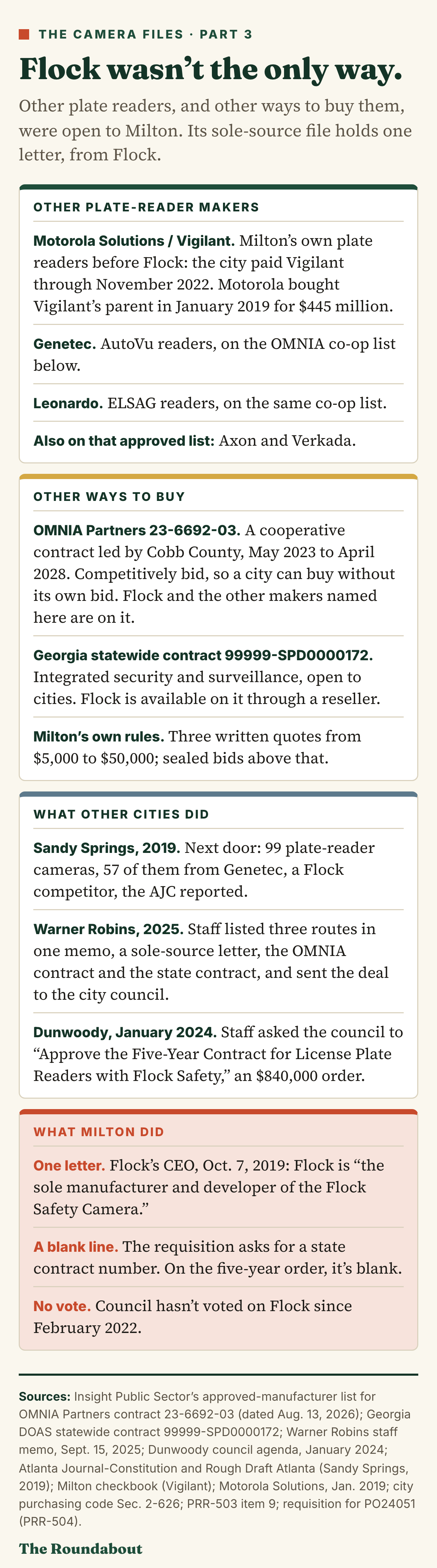
Here is the rule in plain terms. For purchases of $5,000 to $50,000, Milton’s purchasing code requires three written quotes; above that, sealed bids. The city can skip both only if it determines there is just one source, and it must keep “a separate file of sole source procurements” kept “as a public record.”
We asked for that file. The city sent one record: a one-page letter from Flock’s founder and chief executive, Garrett Langley, dated Oct. 7, 2019, to Sgt. Mulvey. “Flock Safety is the sole manufacturer and developer of the Flock Safety Camera,” it says.
That’s Ford certifying it’s the only company that makes Fords. It is Flock’s letter, not a city determination: the vendor vouching for itself. Langley is the same Flock executive who joined the Atlanta Police Foundation’s board of trustees in 2025; Councilmember Cookerly sits on the foundation’s executive committee. Milton’s code also lets the purchasing agent stay with a brand for additions to a system “previously selected by the city,” which fits the city’s view that each order continued the 2022 deal. The city produced no record of either choice. On all three Flock purchase requests from fall 2025, the lines for a second and third quote are blank.
In Milton’s file, the vendor’s CEO stands in for the city’s decision. The code says the city must determine that only one company can do the job. The city’s purchasing agent, by its own code, is City Manager Steven Krokoff. The file holds no determination from him. It holds a letter from the company that got the business.
Sole source is for something only one company can sell. Plate readers aren’t that. Other plate readers were available, and Milton knew it. The city itself bought plate readers from another company, Vigilant Solutions, for years before and after it signed with Flock; the checkbook shows annual Vigilant subscriptions through November 2022. Vigilant is no small shop. Motorola Solutions, the police-radio giant, bought its parent company in January 2019 for $445 million, nine months before Flock’s “sole source” letter. Next door, Sandy Springs agreed in 2019 to 99 plate-reader cameras, 57 of them from Genetec, a Flock competitor, at about $500,000 a year for the system, the Atlanta Journal-Constitution reported.
Since May 2023, a cooperative purchasing contract led by Cobb County, OMNIA Partners 23-6692-03, has let governments buy technology through a reseller without running their own bid. Its current list of approved makers includes Flock and other plate-reader makers, including Motorola Solutions, Vigilant’s owner, along with Genetec and Leonardo. When Warner Robins bought Flock in 2025, its staff listed three routes in one memo: a Flock sole-source letter, a national OMNIA contract, and Georgia’s own statewide contract, “99999-SPD0000172-003,” through a Flock reseller. Staff sent the deal to the city council as a resolution.
Milton’s own requisition form asks the question. “For items purchased off a State contract include the contract #,” it says. On the five-year order, that line is blank.
What Milton’s rules say
The table sets Milton’s written rules beside what the city produced or said this week. A missing record does not prove a step was skipped, and the city’s position is that the 2022 approval and each year’s budget cover every order since.
The Charter’s delegation clause, added in 2018 by Resolution/Ordinance 18-06-363, lets Council delegate to the City Manager contracts up to $50,000 “with a term of no more than a single fiscal year, upon the requirement that such contracts be subsequently ratified by Council.” It says Council may do so “by Ordinance.” We asked for that ordinance. The city sent the 2018 Charter amendment.
Their side
The city’s case deserves a full hearing, and much of it is on the record.
Council did vote on Flock in 2019 and in February 2022, after the city attorney’s firm, Jarrard & Davis, reviewed the 2022 agreement. The mayor signed it. City Manager Steven Krokoff reviewed it too. The add-on Council approved lets the city add cameras “via purchase order,” and the city says those orders “become addenda subject to the agreement’s terms.” The department told us in September that the $63,500 it paid in November 2024 was “an annual renewal under that previously approved agreement and the Council-adopted annual budget,” and that it sought no new bids because the renewal “was a continuation of the existing Flock system and services under the Council-approved agreement.”
“Neither agreement is presently operating under a binding five-year financial term,” the city told us. The five-year references, it said, “relate to pricing and payment terms.” The same add-on, if it governs, lets the city end the deal each year.
The money was budgeted every year. Keeping data a year is legal in Georgia. The department says older records have helped corroborate evidence that arrived later, and it treats a camera hit “as one investigative tool alongside other evidence.” The new policy adds monthly audits. Krokoff wrote on Oct. 2 that the city will “share any decisions resulting from our review when they are made.”
Jamison told us Oct. 12 he wasn’t told the program had grown to 36 cameras or that data now stays 365 days, and that he sees decisions like that as “operational ones.”
We sent our questions to Krokoff, Griffin, Harvill, Mayor Jamison, Councilmember Cookerly, City Attorney Ken Jarrard and the city’s spokesman on Oct. 17. None responded by publication.
What we still don’t know
- Who signed the five-year order for the city.
- What the department’s policy said between Aug. 26 and Oct. 15 of this year.
- Whether the City Manager ever approved the year of retention in writing, as the department says he authorized it.
- Whether anyone at the city checked another way to buy plate readers before calling Flock the only source.
- What Harvill’s numbers showed, if Mohrig ever got them.
We are asking for each in writing.
Three years before DeFranco asked her question, a Council member asked his, inside the room, about the line that appears to carry the cameras’ bills. The answer named the radios and the records system, which may well have been most of it. It didn’t name Flock.
The renewal comes next. Flock’s renewal bills have arrived each October, and the city has paid them in November: $106,200 last November alone. If Council wants a say this year, this is the month to ask.
How we reported this. This story comes from the city’s own records, its budget books and recordings of its meetings. We sent the city specific questions before publishing; on Oct. 2 the City Manager declined all 44 of our earlier ones. Where the city hasn’t answered and the records leave a gap, we say so. If the city believes anything here is wrong, we’ll correct it in plain sight, as we do below.
Correction: Part 1 of The Camera Files said an October 2025 Flock bill for $26,500 covered “six more cameras.” It renewed six cameras added in October 2024; it did not add new ones.
The records behind this story
- The city’s answers to PRR-503, 504 and 505 (Oct. 16, 2026), item by item.
- The Oct. 2023 requisition and five-year order form.
- The fiscal 2025 subscription schedule.
- The Oct. 15, 2025 retention order and the June 2026 amendment.
- Flock’s Oct. 7, 2019 letter.
- Policy 500-016, issued Oct. 15, 2026.
- The plate-reader lines in every city budget since 2021, and the record of the 38 budget meetings we searched.
- City Council video: the Aug. 14, 2023 work session (at 46:49) and the Sept. 9, 2026 regular meeting.
The Roundabout
Get the next Camera Files report in your inbox
The Roundabout is free and Milton-only, Tuesday, Thursday and Sunday at 7 a.m. What our records requests turn up runs here.
Already a subscriber? Use the same email and we'll recognize you. We never sell your address.