
Milton moves to buy 51 acres off Windward Parkway for a park district
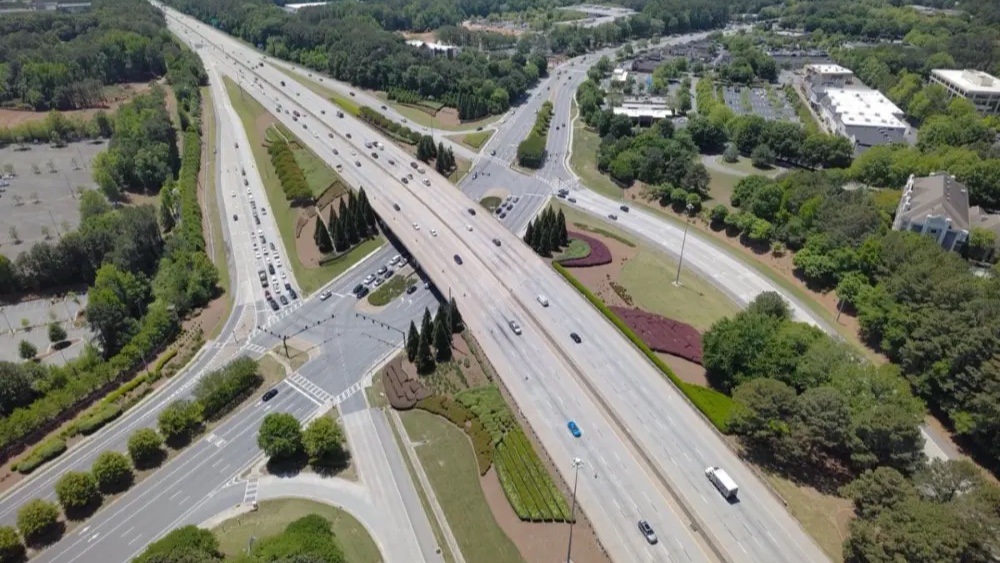
The City of Milton wants to build a park district on 75 acres off Windward Parkway. Monday night it takes the first step: a $26.25 million agreement to buy the three empty office buildings on the Verizon campus, between Deerfield Parkway and Morris Road, and tear them down. The purchase and sale agreement for the 51.32 acres at One, Two and Three Verizon Place is on the City Council agenda posted Thursday afternoon. The price: $26,250,000.
Fulton County carries the two parcels at $50,041,500 for 2026. But $28 million of that is the three office buildings, and the city says they are worth nothing to it. Measured against the land alone, which the county values at $22 million, the city would be paying about $4 million more than the assessor’s figure, and then paying to tear the buildings down. Verizon appealed the county’s 2025 value; the 2026 figure is unchanged.
Nobody has worked there for six years. The sellers are Cellco Partnership and GTE Wireless, both Verizon Wireless entities. Verizon told The Roundabout on Friday that there have been no employees on the site since 2020. The people once based there are now hybrid workers assigned to Verizon’s campus at 5055 North Point Parkway in Alpharetta, or work from home, and the company says no jobs are affected by the sale. It would not say how many people had worked there. Verizon will keep an antenna on the property after the sale, which the agreement provides for.
“We appreciate the City of Milton for being an outstanding partner in this matter,” a Verizon spokesperson said in a statement. “While we are consolidating our local office footprint, we remain deeply committed to north Fulton and the state of Georgia through a strong presence, including our corporate campus in Alpharetta, along with our retail stores and ongoing investment in delivering a high-quality network communications service across the state.”
The buildings are the point of the demolition, not the purchase. The city’s staff report calls them “liabilities that the City anticipates demolishing.” The value, it says, “lies in the land, road frontage, location, and proximity to the City’s two previously acquired Deerfield parcels.”
Those two parcels are 300 Deerfield Parkway, 21.37 acres the city bought from Crescent Communities for $8 million in July 2024, and a 3-acre piece next door it bought that December for $750,000. With Verizon, the city would hold 75.74 acres in Deerfield, bought for $35 million before demolition, cleanup and construction. All four parcels are on our interactive map.
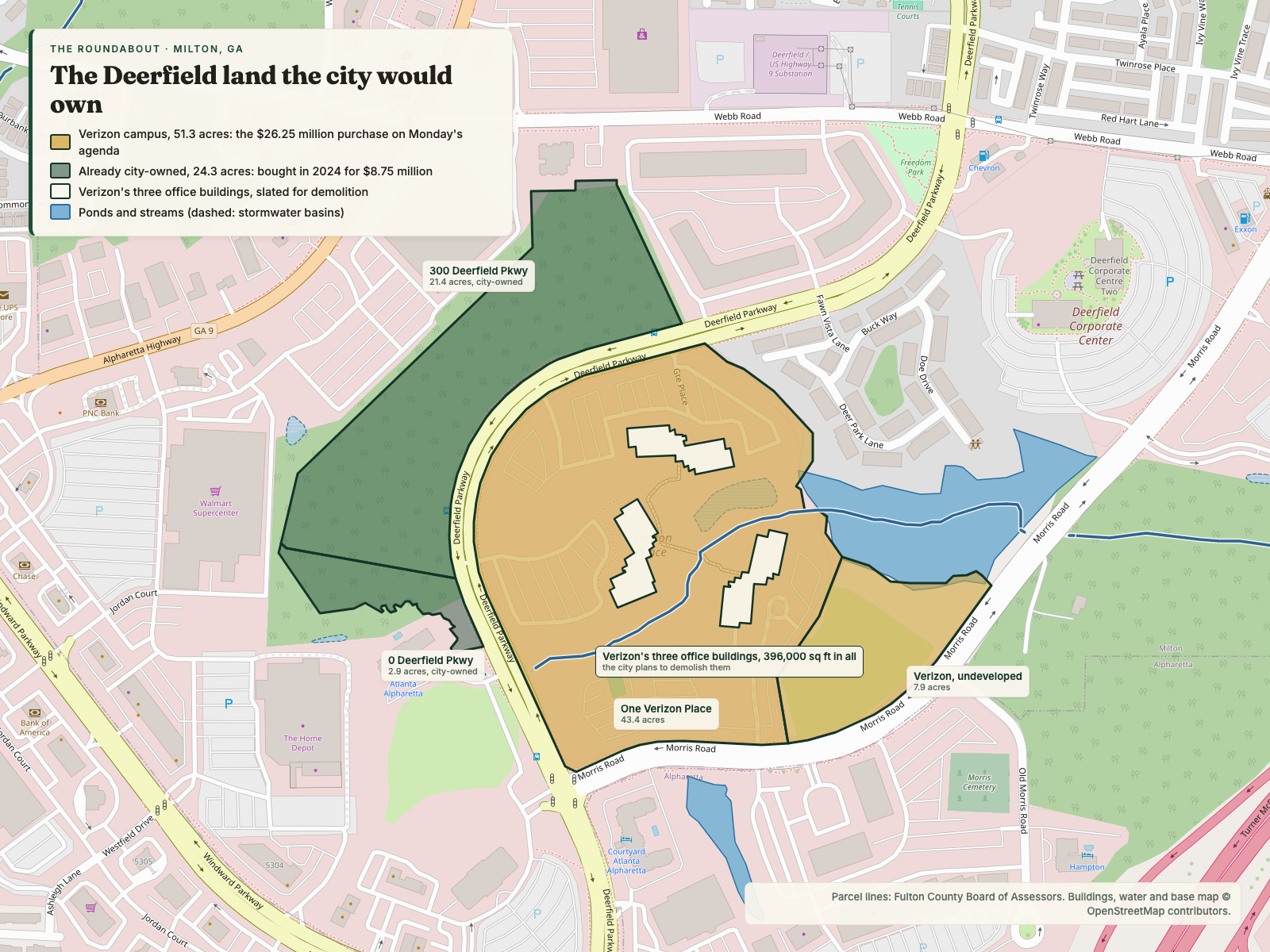
What the city says it wants to build: a recreation-centered district. Athletic fields, trails, open space, gathering places, and what the report calls “complementary commercial uses.” No specific facility is approved by the agreement, and the report says the program, scale and phasing “must be determined through technical analysis, public input, affordability review, and later Council action.”
 | “Owning the land lets the city and its residents decide where recreation, trails, and open space go before private development decides it for us.” Milton Mayor Peyton Jamison, in a written answer to The Roundabout |
How the city says it would pay for it. Part of the plan is to sell pieces. The new Milton Development Authority, seated Sept. 8, would test “whether selected portions of the 51.32-acre Verizon property could be sold to reduce the City’s net investment basis, support the retained recreational core, and create taxable commercial enterprises.” Any sale would need its own Council vote.
The rest is not settled. The report says the funding source “and any required budget amendment must be confirmed by Finance before final action,” and the agreement is not contingent on the city getting financing. A separate item Monday would apply for a federal outdoor recreation grant, through the Georgia Department of Natural Resources, that pays half of land and park costs. The staff memo puts the cap at $15 million and says the city’s half would come from money “that has been set aside for this project.”
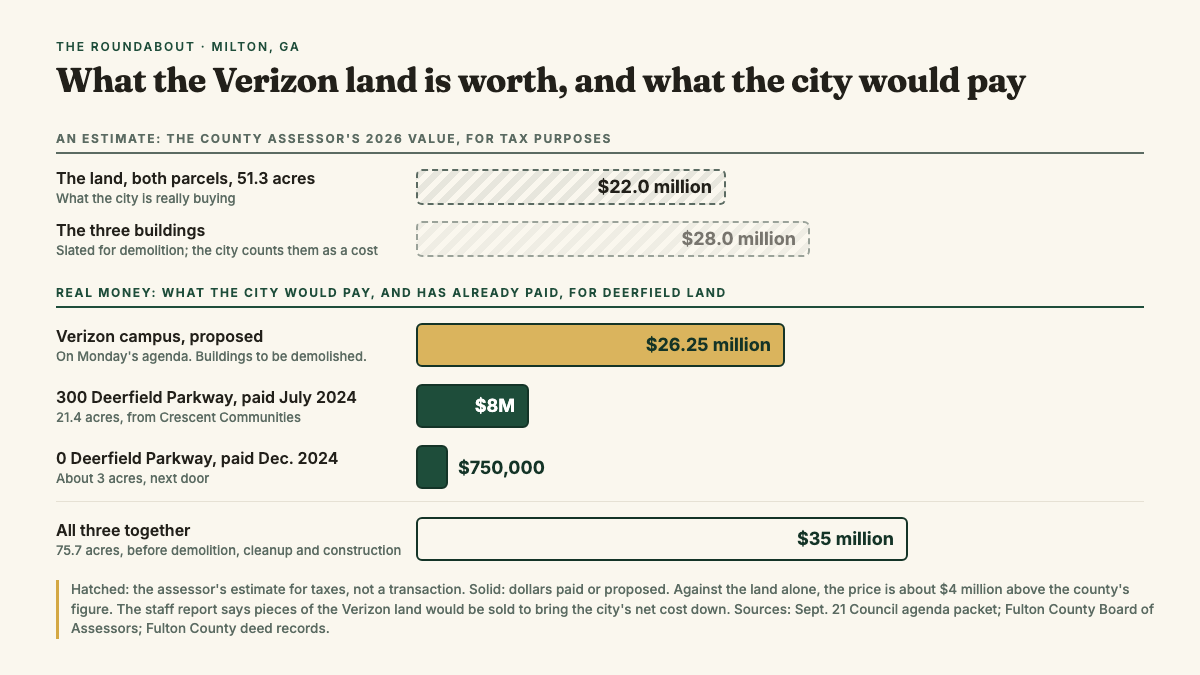
Where the money comes from. The city expects to pay cash from its pay-as-you-go capital program and does not anticipate borrowing, City Manager Steve Krokoff told The Roundabout on Friday. The projects in that program run on different schedules, so the approach being evaluated “would use available funds now and replenish them through property-sale proceeds in time to meet the scheduled needs of those projects,” he wrote. The money set aside for the athletic complex “will likely be an initial source of funding.”
The city’s own books, in the same packet, show what that means. The Capital Projects Fund held $53.3 million on June 30. Of that, $22.9 million is already set aside and unspent for a new active athletic complex in Deerfield, the project the grant application says the land would serve. Much of the rest is already assigned to projects such as Fire Station 45 and the trail connection to the Big Creek Greenway.
The $3.33 million the city paid to settle the Chang case came out of the General Fund, not the capital fund. This year’s legal budget was amended from $725,000 to $4.06 million; the amount added, $3,333,333, is the city’s share of the settlement to the dollar. A $26.25 million purchase paid in cash would use up the athletic-complex money and then some, which is why the plan leans on selling pieces and on the grant. The report asks Finance to confirm the source, and to run the numbers for parcel sales that come late or come up short, before the second vote. On the grant, Krokoff said the cap is $15 million, the memo’s typo has been corrected, and a full award would need a matching $15 million from the city. It is “a potential opportunity to reduce the local cost of the project, not funding that should be described as already secured or even depended upon.”
Monday’s vote is not the last one. Approval would put $100,000 in escrow and start a 60-day due-diligence period in which the city can walk away for any reason and get the deposit back. Staff recommends a second public Council vote before the city commits, at which point another $500,000 goes into escrow. The city does not yet have an independent appraisal; the mayor and the city manager both say that, an environmental review and demolition estimates are what the 60 days are for. Talks with Verizon “have been underway for several months,” Krokoff said, and the Council has discussed the purchase in at least two closed sessions, as state law allows for real estate. Closing would be on or before Dec. 1, 2026. Verizon can push that back up to 120 days to put up a temporary antenna, and keeps an easement for its antennas on the site after the sale. The city takes the property “as is.”
Also Monday: a 30-day freeze on new development in South Deerfield. A resolution would bar the city from accepting new rezoning, use permit, site plan and land disturbance applications in the study area bounded by Highway 9, Webb Road, GA 400 and Windward Parkway, while the authority and staff review the area “holistically.” The resolution says the acquisition “may materially affect development expectations in and around the property.” No applications are pending in the study area that the freeze would affect, the city said.
No borrowing, and not until Chang was settled. Mayor Peyton Jamison confirmed in writing Friday that the city does not expect to borrow for the purchase, and that it held off on the project until the Chang case was resolved. The Council approved a $10 million settlement of that case on Aug. 24, with $3.33 million coming from the city’s fund balance; the city had put its potential exposure at about $44 million.
Why this site: “It’s the largest redevelopment site in Deerfield, which is one of the densest, most walkable parts of Milton and the area with the least access to public recreation,” Jamison wrote. Owning the land, he said, “lets the city and its residents decide where recreation, trails, and open space go before private development decides it for us.” He added: “Quite frankly, some of what we were seeing from prospective developers did not align with Milton’s long term vision.”
On timing, the mayor said he expects the athletic facilities to come first, with land not needed for recreation sold to private developers and the existing buildings coming down. “Our goal is to start construction on the athletic complex in the first quarter of next year,” he wrote.
On the price: “The county’s $50 million values an office campus. We’d be buying land for a park with a mix of commercial uses. The buildings are liabilities to the city, not assets.” Whether $26.25 million is the right number, he said, “is exactly what the next 60 days are for: an independent appraisal, environmental review, and demolition and remediation estimates. If the numbers don’t hold up, the city can terminate.” Asked how the price was set, Krokoff said it “reflects the City’s preliminary assessment of the property’s value and potential,” to be tested in due diligence. The full answers from both are at the end of this story.
What comes off the tax rolls. The campus pays the City of Milton $90,134.75 a year in property tax, the city said Friday: $84,656.40 on the main parcel and $5,478.35 on the smaller one. Property tax is owed whether or not a building is occupied. Land the city owns pays none, so that amount leaves the city’s books at closing, while the pieces it sells would go back on the rolls. Krokoff cautioned that any projection of what those pieces would pay “should not be presented as guaranteed” before the Development Authority’s analysis.
What we asked, and who has answered. The Roundabout sent questions Thursday evening to Mayor Jamison, to City Manager Steve Krokoff and Communications Director Greg Botelho, and to Verizon. All three answered Friday. The mayor’s and Verizon’s answers came before this story published at noon; the city’s came an hour later and were added at 5 p.m. Everything they said is above, and the mayor’s and the city’s written answers are printed in full below.
The Council meets Monday, Sept. 21, at 6 p.m. at City Hall. The purchase is item 12D, near the end of the agenda; public comment comes near the top. The full story runs in Sunday’s issue.
On the recordThe mayor’s answers, in fullThree questions from The Roundabout, three written answers from Mayor Jamison, received Friday morning. Tap to read.
Why the Verizon campus, and why now?
“It’s the largest redevelopment site in Deerfield, which is one of the densest, most walkable parts of Milton and the area with the least access to public recreation. It sits near the two Deerfield parcels the city already owns. Together that’s about 75 acres, which allows us to plan the district as a whole, on a blank canvas, instead of reacting to it one parcel at a time. Quite frankly, some of what we were seeing from prospective developers did not align with Milton’s long term vision. Owning the land lets the city and its residents decide where recreation, trails, and open space go before private development decides it for us. It also puts a stake in the ground: we are serious about putting active, city owned parks along Milton’s perimeter, where the density already is, so that the rural heart of Milton stays preserved as greenspace, with less traffic.”
What should residents expect to see on the land, and when?
“Recreation is the core: athletic facilities, trails, open space, and gathering areas serving all ages and abilities. Across all of the city’s Deerfield parcels, the goal is a mixed use district built around a community park and recreation destination. This is extremely early, and the Development Authority needs to take a hard look over the next 60 days. But my expectation is that the athletic facilities come first, and that land not needed for recreation would then be sold to private developers willing to build something truly unique, which would reduce the city’s net cost and add to the tax base. The existing buildings would come down. On timing: 60 days of due diligence, and closing on or before December 1 if we proceed. Our goal is to start construction on the athletic complex in the first quarter of next year.”
The county values the land alone at about $22 million and the buildings at $28 million, and the staff report calls the buildings a cost. How do you see the $26.25 million price?
“The county’s $50 million values an office campus. We’d be buying land for a park with a mix of commercial uses. The buildings are liabilities to the city, not assets. We also look at this in total: combined with the roughly 25 acres the city already owns across the street, this would give Milton more than 75 acres for about $35 million. I believe owning that much contiguous land in North Fulton will prove to be a good long term investment for our taxpayers. That said, whether $26.25 million is the right price is exactly what the next 60 days are for: an independent appraisal, environmental review, and demolition and remediation estimates. If the numbers don’t hold up, the city can terminate.”
On the recordThe city’s answers, in fullTen questions from The Roundabout, answered in writing by City Manager Steve Krokoff on Friday afternoon. Tap to read.
Krokoff opened with this: “This proposal is about giving Milton and its residents the ability to shape an important part of Deerfield around recreation, public space, and complementary private investment. The proposed agreement preserves that opportunity while allowing the City to evaluate the property, the costs, and the financial assumptions before making a final decision to proceed.”
1. Funding. Which fund does the city expect to pay from? Is the $22.9 million allocated to the new active athletic complex the intended source? Does the city expect to issue debt for any part of this?
“The City expects to use available cash within its pay-as-you-go capital program and does not anticipate borrowing for the purchase. Our PAYGO program sets aside funding for capital projects over time. Because those projects have different schedules, the approach being evaluated would use available funds now and replenish them through property-sale proceeds in time to meet the scheduled needs of those projects. The funds set aside for the athletic complex will likely be an initial source of funding.”
2. Appraisal. Has the city obtained an appraisal of the property? If so, what did it conclude, and will it be public?
“An independent appraisal is part of the planned due-diligence process. That work, together with environmental review and demolition and remediation estimates, is intended to test the acquisition’s economics before the City decides whether to proceed.”
3. The price. The county’s 2026 value is $22.0 million for the land and $28.0 million for the buildings. The staff report treats the buildings as a liability. How was the $26.25 million price arrived at?
“The proposed $26.25 million purchase price is for the property as a whole. The County’s assessed values reflect the site’s current use as an office campus. The City is evaluating the property for a different long-term purpose that would include recreation, public space and complementary commercial uses. Because the existing buildings are expected to be demolished, the City is not relying on their assessed value when evaluating the acquisition.”
“The proposed price reflects the City’s preliminary assessment of the property’s value and potential. That assessment will be thoroughly tested during the due diligence period, including a review of the overall property’s condition, development considerations and other relevant financial and operational factors. The City will use those findings to determine whether the proposed acquisition represents a sound investment for the community.”
4. Demolition. What is the city’s current estimate for demolition and any remediation of the three buildings, and what is known about the buildings’ condition?
“The City anticipates demolishing the existing buildings rather than renovating or operating them. That is why the staff report treats them as liabilities in the acquisition analysis instead of assigning them value as usable City facilities.”
“Due diligence is intended to establish the buildings’ condition and the costs associated with demolition, any required remediation, utility disconnections, and site preparation. It must also identify potential hazardous materials and other structural or site risks. Those costs need to be considered as part of the full public investment, not treated as an afterthought to the purchase price.”
5. Taxes. What does the campus pay the City of Milton in property tax today, and what does the city project it will collect from the portions it intends to sell?
“$90,134.75 in City property taxes, consisting of $84,656.40 for one parcel and $5,478.35 for the other.”
“The longer-term strategy is to retain the land needed for recreation and public purposes while integrating thriving businesses on selected portions of the property. Those private uses could generate recurring tax revenue, while the proceeds from parcel sales could reduce the City’s net acquisition cost.”
“A dependable future revenue projection requires more than assuming that land will be sold. It depends on the parcels ultimately offered, their development, taxable values, and timing. The Development Authority and our team are expected to evaluate those assumptions. The goal is a lasting recreational benefit supported by productive private investment, but projected revenue should not be presented as guaranteed before that analysis is completed.”
6. Verizon. What has Verizon told the city about its plans: is it leaving the site, keeping any operations there beyond the antenna easement?
“The agreement preserves specified telecommunications rights through an antenna easement and provides a 60-day post-closing license for the sellers to remove specified personal property.”
7. Parcel sales. Which portions does the city expect to sell, by what process (sealed bid, broker, negotiated), and on what timeline?
“The first priority is to determine what land must be retained for recreation, public access, infrastructure, open space, and long-term flexibility. The Development Authority would then evaluate which remaining portions could support complementary private investment without compromising those public purposes.”
“The specific parcels, transaction process, and timing should follow that analysis, including surveys, valuations, market conditions, and infrastructure needs. The staff recommendation calls for future Council review and approval of any parcel disposition. The purpose of selling selected land would be to reduce the public investment and add businesses that support the district, not to dispose of property before the recreational plan is understood.”
8. Process. When did negotiations with Verizon begin, and how many executive sessions has Council held on the property?
“Discussions with Verizon have been underway for several months, and the potential acquisition has been discussed during at least two executive sessions, as permitted by law for real estate matters. The Council’s focus now is on a thorough due diligence process. This period will allow the appropriate experts, including those serving on the Development Authority, to evaluate the property and give community members an opportunity to provide input before the City makes a final decision.”
9. The moratorium. Are any applications now pending in the South Deerfield study area that the 30-day moratorium would affect?
“No.”
10. The grant. The ORLP memo lists the maximum as “$15,0000,000.” Is the cap $15 million?
“Yes. The maximum identified in the grant materials is $15 million, and the typographical error has been corrected. The funding discussed is a 50-50 matching grant, so a maximum $15 million award would require a corresponding $15 million City match.”
“This is a potential opportunity to reduce the local cost of the project, not funding that should be described as already secured or even depended upon. The City’s interest is in pursuing available assistance while evaluating the acquisition on a sound financial basis.”
Sources: the Sept. 21 City Council agenda packet, pages 911 to 1007 (the staff report, the purchase and sale agreement, the moratorium resolution and the grant resolution); the Fulton County Board of Assessors’ records for parcels 22 544011140234 and 22 544011150290, read Sept. 17; written answers from Mayor Jamison, from Verizon and from City Manager Steve Krokoff, all received Sept. 18.
The Roundabout publishes three mornings a week, free, Milton-only. The full story runs in Sunday's issue, and it can be in your inbox.