
FRIDAY, AUGUST 21, 2026 · Issue No. 47 · 5 min read
Milton votes Monday on a $10 million settlement
A $44 million exposure, a $3.33 million payment, and the mayor on the record with us.
Special Edition
The Milton City Council votes Monday night on a $10 million settlement that would end the nine-year Chang case. The city would pay $3,333,333.33 out of fund balance. GIRMA, the insurance pool that covers Milton, would pay $6,666,666.67. The agreement resolves every remaining claim, provides mutual releases, and carries no admission of wrongdoing by anyone.
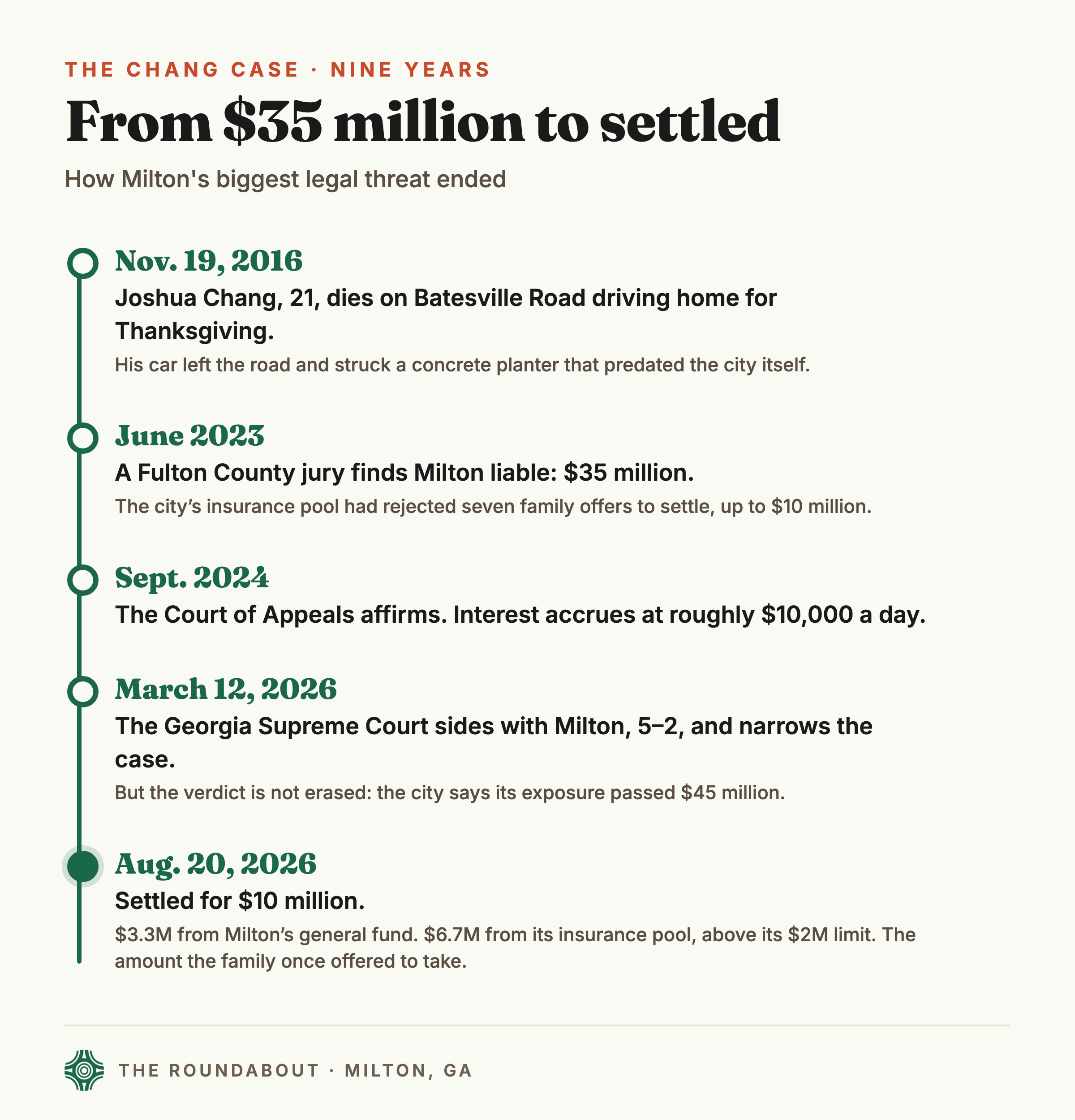
The number carries a weight the figures alone do not show. Before the 2023 trial, the Chang family offered to settle seven times, for as little as $1.75 million and as much as $10 million. GIRMA, which alone held settlement authority, said no every time. Nine years after Joshua Chang died on Batesville Road, the case ends at the top number the family once asked for.
How we got here
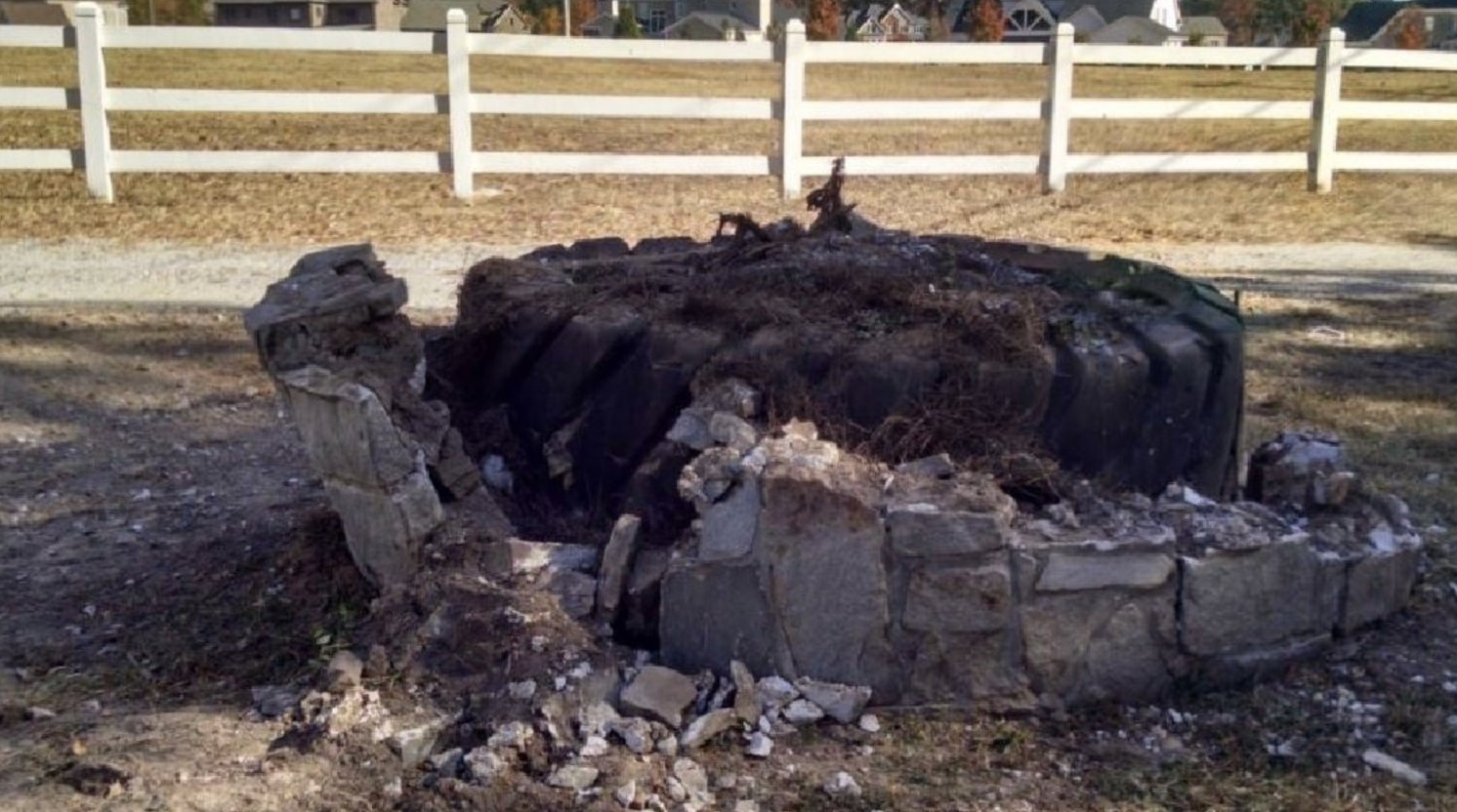
On November 19, 2016, Joshua Chang, 21, was driving home for Thanksgiving when his car left Batesville Road and struck a stone and tire planter sitting about six feet off the pavement, between two driveways, inside the city's right-of-way. Police found no speeding, no recklessness, no phone. He was a Yale senior on full scholarship, a Woodstock High salutatorian, an engineer who once built a bicycle out of bamboo. He had texted his mother at 7:05 that he was on his way.
His parents sued in 2018. In June 2023, a Fulton County jury found the city liable on two separate grounds, negligence and nuisance, and awarded $35 million, reduced to $32.55 million for Joshua's share of fault. The Court of Appeals upheld it in 2024. Interest kept running the entire time.
This March, the Georgia Supreme Court handed Milton what looked like a rescue: a 5-2 ruling that a city's duty to keep roads safe applies in the lanes of travel and not to the roadside beyond them. Dozens of Georgia cities had filed briefs backing Milton, warning that the verdict would make every mailbox, utility pole and subdivision marker in a right-of-way a liability. Two justices dissented, arguing the shoulder is an area the public has a right to use.
But the rescue was narrower than the headlines. "But that is all we decide," the majority wrote. The jury's verdict rested on a second, independent ground, nuisance, that the court left standing, and it sent the case back to the Court of Appeals to decide that question. The $32.55 million never disappeared. Rather than wait for that ruling, the city went to mediation on July 29, where the proposed settlement was reached. The city says the mayor and Councilmember Carol Cookerly took active roles in those talks.
What it costs, and who pays
Here is the arithmetic that drove the decision. As of August 20, the $32.55 million judgment plus roughly $11.54 million in accrued post-judgment interest put Milton's potential exposure at about $44.09 million. The city is careful to say that figure is context, not a bill it currently owes. Against it, a defined $3.33 million.
That $3.33 million comes from fund balance, the savings the general fund has built up over years. Milton opened this fiscal year with about $17.3 million there, against a reserve floor of roughly $12 million of its own setting. The city says the payment will not reduce services or staffing, delay planned capital projects, change the fund balance policy, or require a tax increase. There is also a smaller number worth noting: Milton has already spent about $90,000 on its own legal fees beyond what GIRMA covered, and that meter was still running.
"The proposed settlement offers closure and a path forward for all involved," Mayor Peyton Jamison said in a statement to The Roundabout. "After nearly a decade of litigation, the City had a responsibility to pursue a path that protected Milton's taxpayers from continued financial and legal uncertainty. The proposed agreement would reduce the City's potential exposure of approximately $44 million to a contribution of $3.33 million, while also bringing an end to the continued accumulation of legal fees and interest."
The insurance side of the payment, $6.67 million, is more than three times the $2 million in coverage the city has publicly described for a claim like this. Why would a risk pool pay several times its limit? Two things in the public record explain it. Among the seven offers GIRMA rejected was one below its own limit, and under Georgia law an insurer that unreasonably refuses a within-limits settlement can be exposed to the entire excess judgment. And a pool does not carry that alone: state law requires risk pools to maintain an excess loss program above member limits, which is what stands behind a payment this size.
What it means for the rest of us
There is a piece of this most residents have already seen without knowing why. Since 2016 the city has rebuilt how it handles fixed objects near its roads. It amended its code to require engineering based safety evaluations of those objects, created a process for ordering removal when city engineers decide it is warranted, issued removal notices for structures that do not comply, and formalized who is responsible for right-of-way permits. If a notice about something at the end of your driveway ever seemed like odd city housekeeping, this case is the reason it exists.
Asked in its own materials whether the settlement is a victory, the city answers plainly: no. "Joshua Chang's death was a tragedy, and the City is not celebrating the loss or the payment."
If the council approves Monday, the agreement takes effect once every party signs. The parties would then jointly ask the Court of Appeals to stop its review, though no one can compel that court to do so. Either way, the city says, once the agreement is signed it controls, and any later appellate ruling would carry no direct financial consequence for Milton. The statewide fight over roadsides ends with no new precedent beyond the March ruling. The planter question, what a city owes for what stands in its rights-of-way, ends the way it began: unresolved in law, resolved in money.
The council meets in a special-called session Monday, August 24, at 6 p.m. at City Hall, 2006 Heritage Walk. It is open to the public. We will be there.
Joshua Chang would be 31 this year. His mother told a reporter after the verdict: "We just wanted justice for Josh."