
The septic tank saved Milton — really
Walk Milton's horse country — the equestrian belt off Birmingham, the wooded acreage off Hopewell, the open land north of 372. You're walking land that physically can't be turned into a Roswell-style subdivision. Not because of the zoning map. Because of the soil under it.
Most of Milton is on septic. No municipal sewer means every house needs a tank, a leach field, and enough land for the drain to work. Georgia's rules force a real minimum — roughly an acre on most Milton soil, often two or more depending on slope and percolation. Sewer to the property line = build whatever the zoning allows. No sewer = the soil sets the floor.
The math. A 100-acre tract with sewer can plan 200 to 400 homes on quarter-acre lots. The same tract on septic? Maybe 50 to 80, on lots an acre or larger. A three-to-eight-times density difference, set by what's underground. You can up-zone on paper. You can't physically build the denser subdivision without the pipes to carry it.
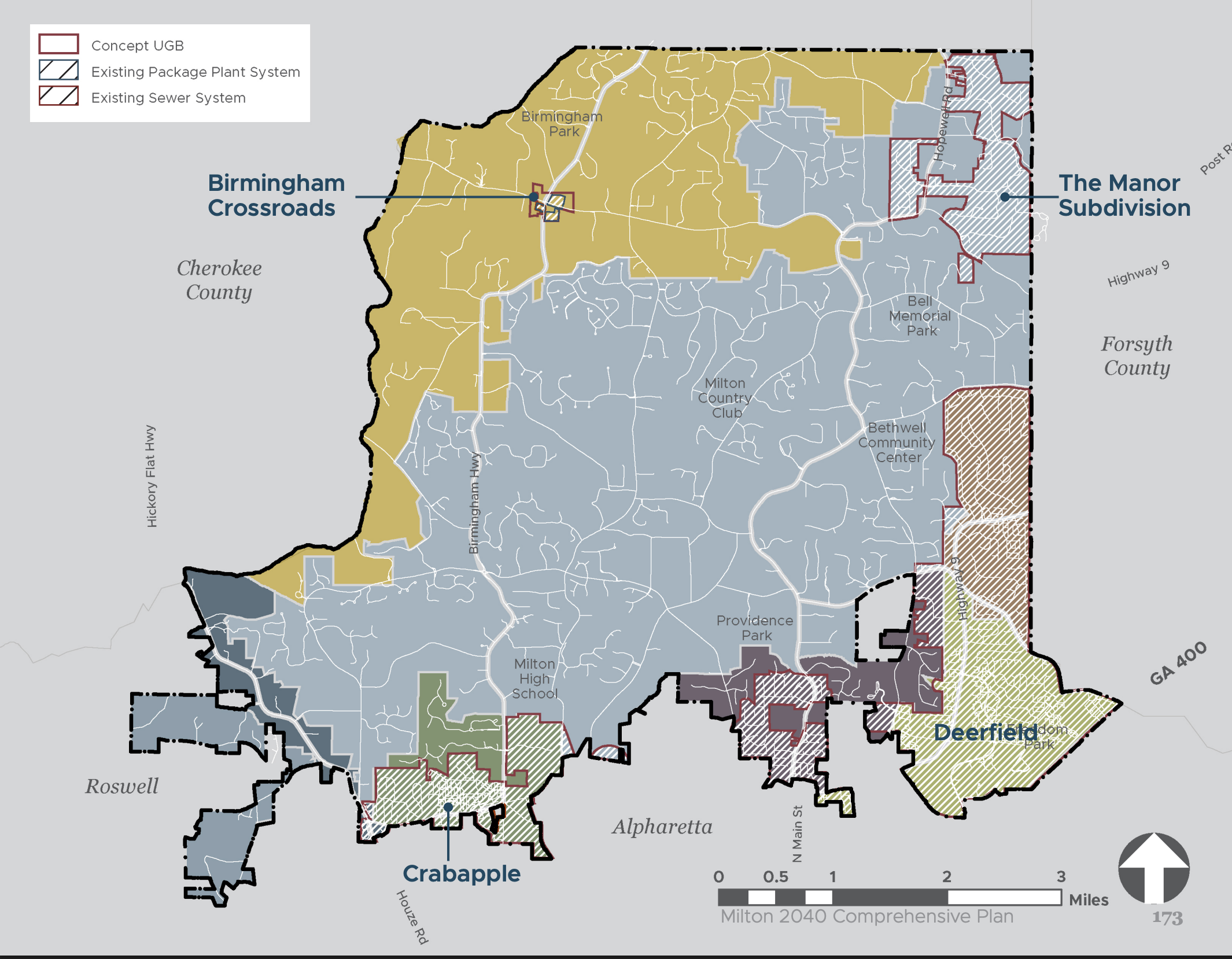
The city's own concept map for an Urban Growth Boundary, drawn on the current allowable sewer extents. The green nodes — Crabapple and Deerfield — are where the pipes already are. The vast gold and blue areas are not. Source: City of Milton 2040 Comprehensive Plan, p.173.
Three layers, not one. Most residents only see the zoning layer. Underneath:
- The ground itself. No sewer, mandatory big lots, full stop. The city even partners with Fulton County to run septic-tank-maintenance workshops — it treats septic as a feature.
- The map. Fulton County's sewer service area puts most of Milton outside the zone where pipes can be extended. The 2040 Comp Plan explicitly asks staff to study a formal Urban Growth Boundary based on "the current allowable sewer extents." The city is openly contemplating making the soft constraint a hard one.
- The incentives. Milton's award-winning Transfer of Development Rights ordinance is already in place in Crabapple, on the Ga. 9 corridor, and on Deerfield Parkway. The city's separate Large Lot Incentives program (three acres and up) waives sidewalk and streetlight requirements for large-lot subdivisions — small concessions that add up to the rural feel residents say they want. The Greenspace Bond has permanently protected over 400 acres so far, with about $5 million remaining to deploy.
What the city already ruled out of the next round of incentives is the tell: no short-term rentals on large lots, no front-yard accessory structures, no "hobby farm" loophole. Each one had advocates. None made it.
Why the next Comp Plan vote matters. The Plan determines where sewer can extend. Sewer determines what density follows. Look at Alpharetta, Roswell, and Johns Creek — the rooftops followed the pipe, not the other way around. Milton's 2040 Comprehensive Plan page on the city website is where the next public engagement events get posted. Worth knowing about, even if you never go.
The horse-country aesthetic isn't an accident. Your septic tank is doing more zoning enforcement than your HOA.
Sources: City of Milton 2040 Comprehensive Plan (Resource Management, Land Use, and Short-Term Work Program chapters); Milton Large Lot Incentives project page; Fulton County Sewer Service Area; Georgia DPH On-Site Sewage Management Systems Manual; Georgia Code O.C.G.A. § 48-5-7.4 (CUVA).
This story ran in Issue #13. The Roundabout publishes three mornings a week, free, Milton-only, and the next one can be in your inbox.